
Fergs Finds
This is a short weekly email that covers a few things I’ve found interesting during the week.

Article(s)
Sometimes it’s easier to make the point with headlines (dates highlighted).


I couldn’t resist a meme.

Podcast/Video
To balance the above, I’m definitely keeping an eye on how rapidly China is overcoming renewable constraints on their grid.
These videos were eye-opening.
China’s renewable power dependency has a major flaw. This transformer just solved it.
Revolutionary generator transforms Chinese factories into power plants.
China builds new water battery to power entire electrical grids.
Quote
Edge isn’t permanent. It decays. The question isn’t whether something works. It’s how long before the market adapts and makes it stop working.
Trading Psychology Stick (from Kevin Muir’s 2025’s TRADING WISDOM)
This quote struck a nerve with me, as whenever I found a “winning angle” in trading, it slowly disappeared over time. The only angles I found that are “evergreen” are having a longer time horizon and behavioural arbitrage.
Tweet/Notes
Great insight into the issues with opening the Hormuz Strait.

Anas is preaching to the converted.

Charts
Waiting for a chart breakout….

I found this breakdown (Unheard: Is Iran winning the war?) on drones and missile launches interesting.
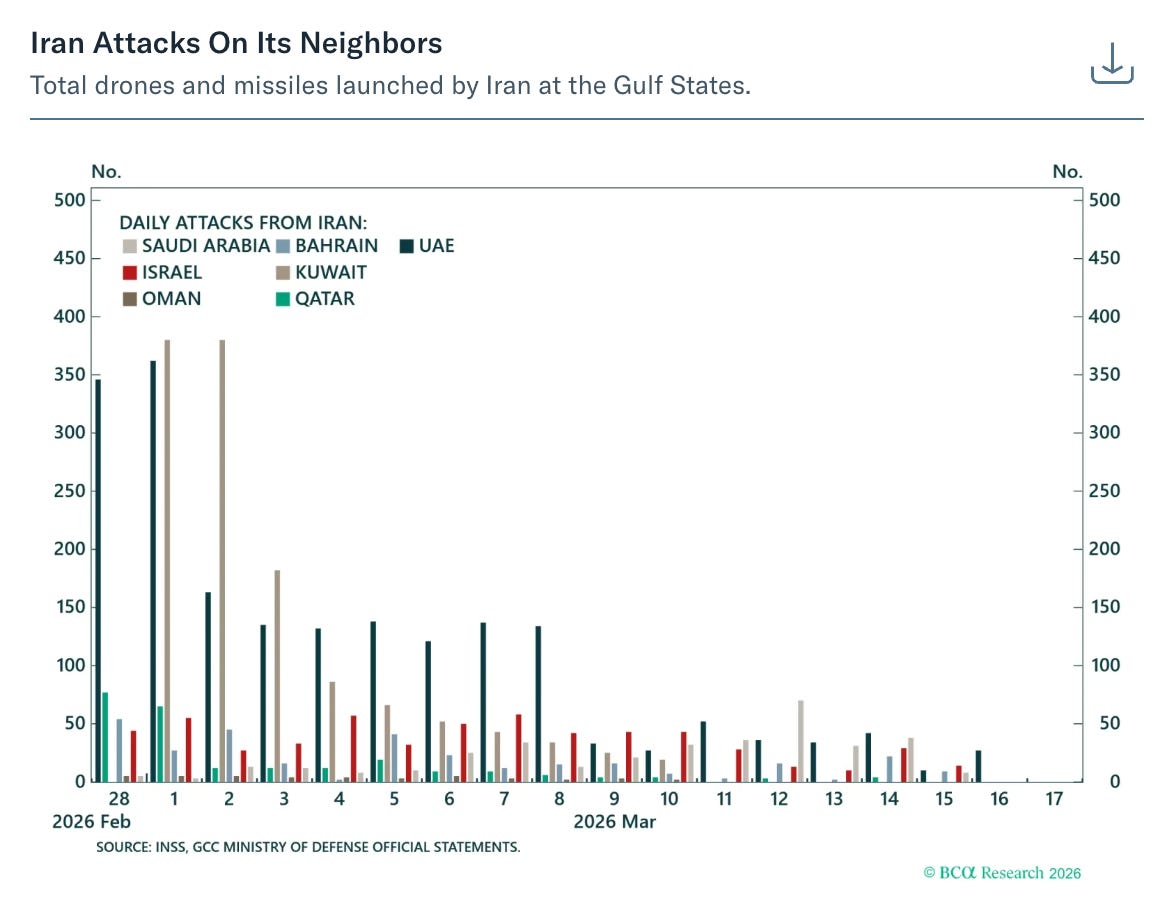
Something I’m Pondering
I’ve been pondering this quote, but with my trading/investing information diet.
A question to determine if you’re thinking critically: what proportion of the books and articles you read do you disagree with? If it’s near zero, then either you’re agreeing with whatever you read, or you’re only reading whatever you already agree with. Both paths lead to idiocy.
-Gurwinder
It’s very easy to build an echo chamber in Substack, podcasts, YouTube, and Twitter.
One investor I really enjoy reading is Erik from YWR, as we come at the market in a similar way, looking for hated out-of-favour sectors, yet draw some very different conclusions. I pride myself on sorting through roadkill no one will touch, yet YWR: Untouchables has some stuff I refuse to touch (renewable energy companies and European autos.) We also have quite different macro outlooks (YWR: 4 reasons we make new highs), and I love seeing his process and how he draws his conclusions.
Solar is another area I am trying to find more experts (I had a great chat with David Dixon, Rystad’s senior renewables analyst). I still hold the view that solar makes little sense in countries in the Northern Hemisphere. What gives me pause is some of the battery and grid breakthroughs I’m seeing, particularly in China (as I shared in the above videos). If sodium-ion or even water batteries prove economic at scale, I’ll need to rethink my entire view of solar’s potential.
Hope you are all having a great week!
Cheers,
Ferg
P.S. I wrote this piece to outline a few of the rules I stick to religiously to protect myself from a dose of FOMO…


I'm an engineer who worked with mechanics and electronics for 15 years. I'm not a power grid engineer so not a specialist there.
Regarding the videos in China I want to give my perspective though:
1. Smart transformers and HVDC
These are already in use in Sweden (which has a similar geographic situation as China: eletricity produced in the north and most of the consumption in the south). Sweden solved that problem over 60 years ago although with an AC grid. Now Sweden has a too large production from intermittent wind and has upgraded the grid with "smart" transformers (I would argue that the grid is the smart one, not perhaps the transformers themselves). There is also both old and new HVDC lines in the south so that too is not a new thing. (Sweden actually build the world's first commercial HVDC powerline in 1954. https://sv.wikipedia.org/wiki/Gotlandsl%C3%A4nken).
So these things are not something that China only can do. They are in fact already in use in a tiny country such as Sweden. However, perhaps this is breaking for China and will drastically improve their industry.
2. sCO2
This part I'm less familiar with but as an engineer I hope I can at least see if I make crazy mistakes so here we go. I tried to use chatGPT and force it to reply only with facts I asked for and not go on the typical crackpot trips.
Traditional ways of converting excess heat from steel plants into electricity apparently involves the Rankine cycle with steam. These have an efficiency of 15-25%. The proposed sCO2 method has an efficiency of 20-35%. So although a large relative improvement, it still is not very efficient. So how much heat is there to be had? ChatGPT estimates 1-3 GW extra would come from applying the sCO2 method to the Chinese steel plants instead of using the steam method. Perhaps 3-9 GW including the broader heavy industry.
How much is that? It corresponds to about 5-15% of China's nuclear fleet. So although not tiny, it isn't a lot either. A problem with sCO2 is that it is apparently most efficient in higher temperatures than a lot of industries run at, so if that can be overcome the numbers would improve.
3. Water batteries
This part I am the least familiar with, but there seem to be some hype in this topic. The text in the video comes from this article:
https://interestingengineering.com/energy/china-energy-dense-aqueous-batteries?utm_source=chatgpt.com
The text is pretty click-baity:
"Researchers in China have developed a water-based battery, which is claimed to be much safer and energy-efficient than “highly flammable” non-aqueous lithium batteries. "
Did they really? The article links to a Nature Energy publication that indeed talks about the chemistry of batteries
https://www.nature.com/articles/s41560-024-01515-9
But did they build a battery? No. They demonstrated battery chemistry. What scale of chemistry did they show? We don't know. Probably milliliters? What scale is needed for a grid batteries? Many millions of liters. Is it easy to scale a lab test by a factor of 100.000.000? Who knows.
I used chatGPT to estimate the amount of iodine needed for a 1TWh battery, a scale that would matter for a 10 million pop country. It came to 0.2–2 million tonnes iodine. That is several times the global annual production. Is it easy to increase the global production by tens-hundreds of times? For iodine chatGPT says no because there is no economical way to produce those amounts of iodine today.
Conclusion
Sorry for using chatgpt in the reply here but I think it still can provide some value. I generally get skeptical when I see headlines like "2x this or that", "built a thing that can make XYZ". There is usually some truth to it but generally only a little bit.
As I see it none of the tech proposed in these videos is like WOOOOOOOW at the moment. Perhaps like lithium in the beginning of the 2000's. A promising tech that indeed improved and got implemented on large (but not grid large) scale over time.
I do have to say that the Chinese impress though. As much as the west impressed 50-100 years ago when we did the same thing: put energy and food security on top of the agenda and cared less about pronouns, DEI and moral lecturing.
And again, I'm not a power grid engineer. Just a dinky little engineering physics engineer.
Cheers!
Can't agree more re: the importance of learning from experts you disagree with. I subscribe to EWR now and then for the same reason.