
Fergs Finds
This is a short weekly email that covers a few things I’ve found interesting during the week.

Article(s)
Trump’s trade deal with South Korea explained in headlines:
South Korea eyes non-binding deal to steer $350 bln U.S. investments.
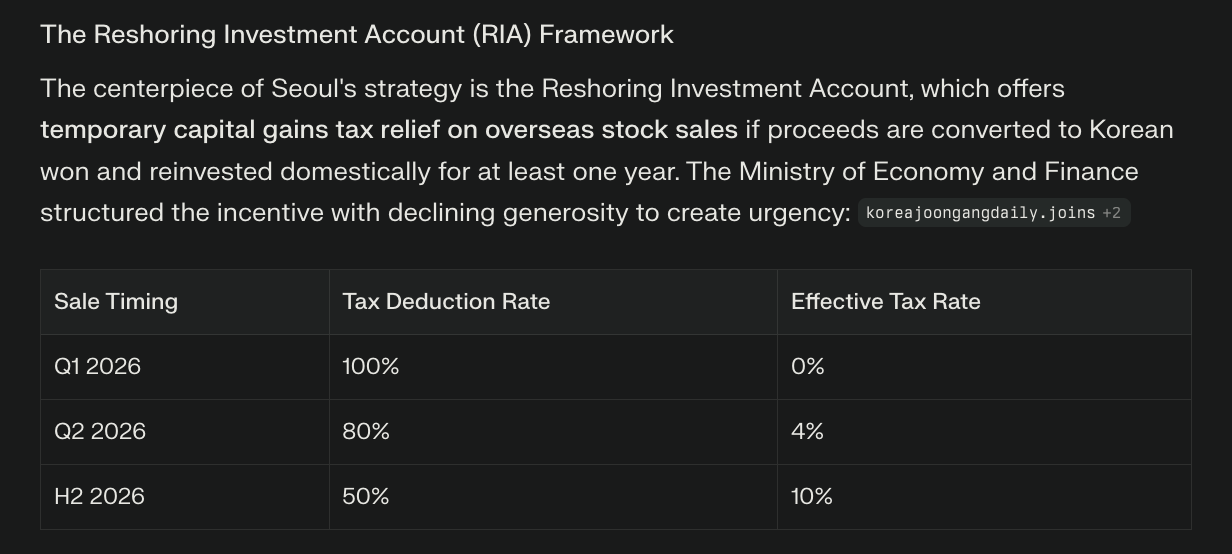
South Korea offers tax breaks on overseas stock sales to stem currency’s slide.
South Korea has deployed an unprecedented fiscal intervention—offering temporary capital gains tax exemptions on overseas stock sales to retail investors who repatriate funds—as the won approaches crisis levels last seen during the 1997 Asian Financial Crisis and 2008 Global Financial Crisis. Announced in December 2025 and formalized in January 2026, the policy represents a novel attempt to stem capital outflows without traditional capital controls, addressing a structural shift in which Korean retail investors have become the largest foreign buyers in the U.S. equity market, accounting for 11% of foreign net purchases in 2025.
Podcast/Video
I love both Erik and Craig’s work: YWR:The Return of Matter
Quote
The factory in Ohio remains half-built, its machines silent, while the paperwork for its most critical components circulates through an endless loop of administrative “reviews.”
-Craig Tindale (The Chokepoint Mandate)
Similar to the “excess capacity” label given to the Chinese industry when it strategically undercuts competitors to gain market share.
“Regulatory limbo” will be a phrase you’ll hear more frequently, whether it’s critical minerals import licenses or H200 chips, which I touched on a month ago regarding Nvidia.
Nvidia’s CEO says China is still finalising licence for H200 chip (January 29, 2026)
“The H200, the actual license for H200 is being finalised. And I’m hoping that also the Chinese government would allow Nvidia to sell the H200, so they have to decide. And I’m looking forward to a favourable decision,” he told reporters at Taipei’s downtown Songshan airport.
“I think that H200 is very good for American technology leadership. It’s also very good for the Chinese market. And the customers would very much like to have H200,” he said.
“And so I’m looking forward to a good decision. And so we just have to wait patiently,” he added.
Citing sources, Reuters reported on Wednesday that China has given approval to ByteDance, Alibaba and Tencent to purchase more than 400,000 H200 chips in total.
However, the approvals came with conditions which one source said were too restrictive, with customers not yet converting the approvals to purchase orders.
Tweet
This chart is so wild I had to fact check China actually installed more power capacity in 2025 than India’s entire installed capacity….or two Germanys if you prefer (before I even start on their widening gap between installed capacity and generation).
China’s Four-Year Energy Spree Has Eclipsed Entire US Power Grid

Charts
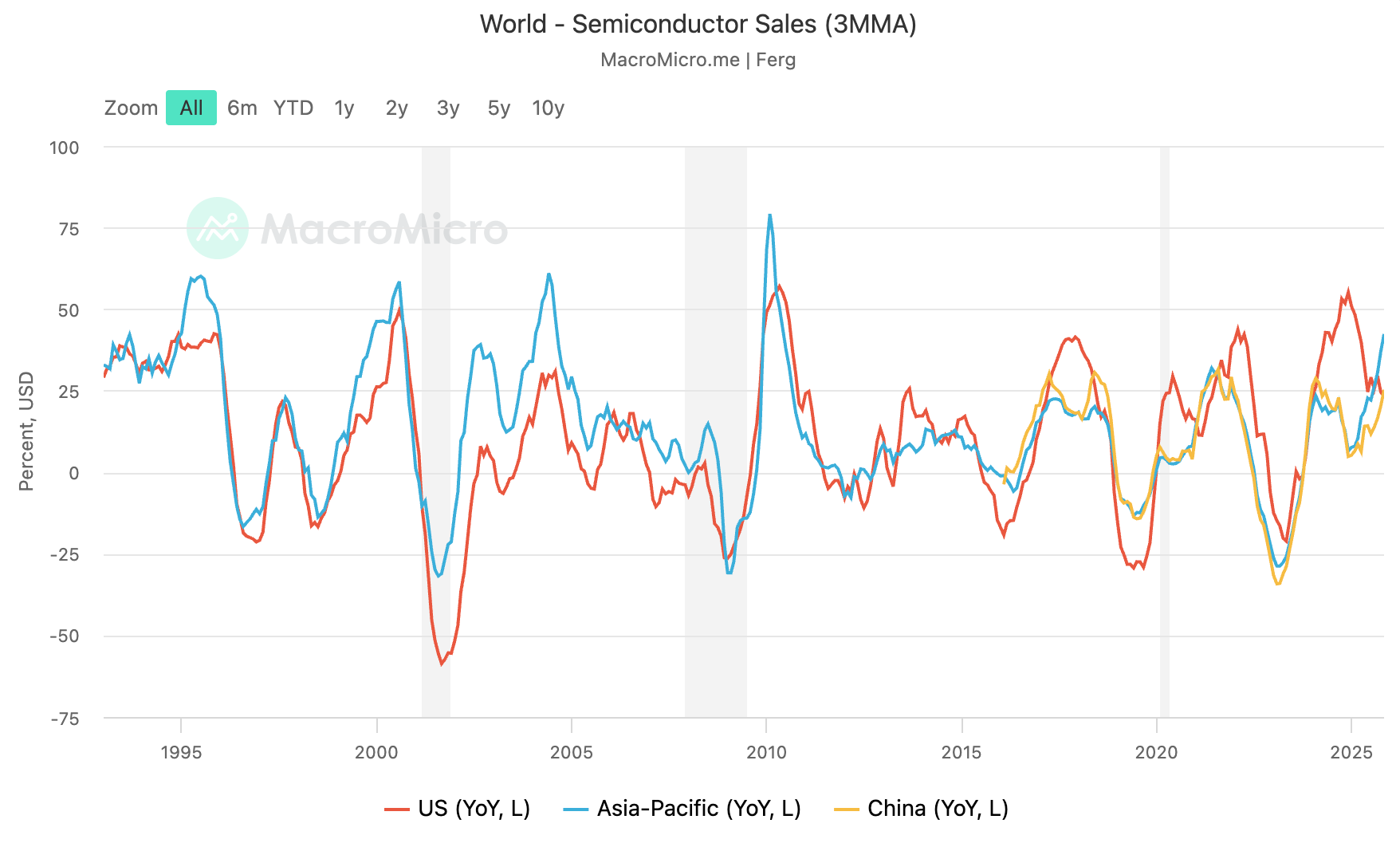
US semiconductor sales rolled over hard at the end of last year. While China and Asia semiconductor sales are grinding higher.
Something I’m Pondering
I’m pondering all I’ve learned since writing this piece just over a month ago: Setting Fire to Paper Markets and following reading Craig’s latest piece: The Revenge of Matter.
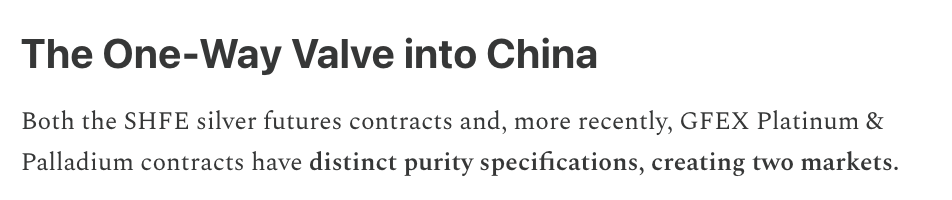
Chinese futures markets are explicitly constructed to “serve the real economy” not speculation.
Chinese futures exchanges mandate RMB-only settlement
Western exchanges like the LME and COMEX see less than 1-2% of contracts result in physical settlement, the Shanghai Futures Exchange (SHFE) operates under a fundamentally different model where physical delivery upon contract expiration is mandatory rather than optional (no cash settlement escape hatch). Traders holding positions at expiration must either deliver physical metal or accept forced liquidation with 20% penalties.
Regulatory Restrictions on Retail Participation (anti-speculation)
Chinese futures markets employ sophisticated mechanisms that channel speculative activity away from near-delivery contracts while preserving physical settlement capacity for commercial users:
Individual investors—representing 97% of all Chinese futures market participants—are prohibited from trading nearby contracts. This regulatory fence forces retail speculation into distant contracts (typically 3+ months from expiration) while reserving near-term contracts for institutional and commercial hedgers with genuine delivery intentions.
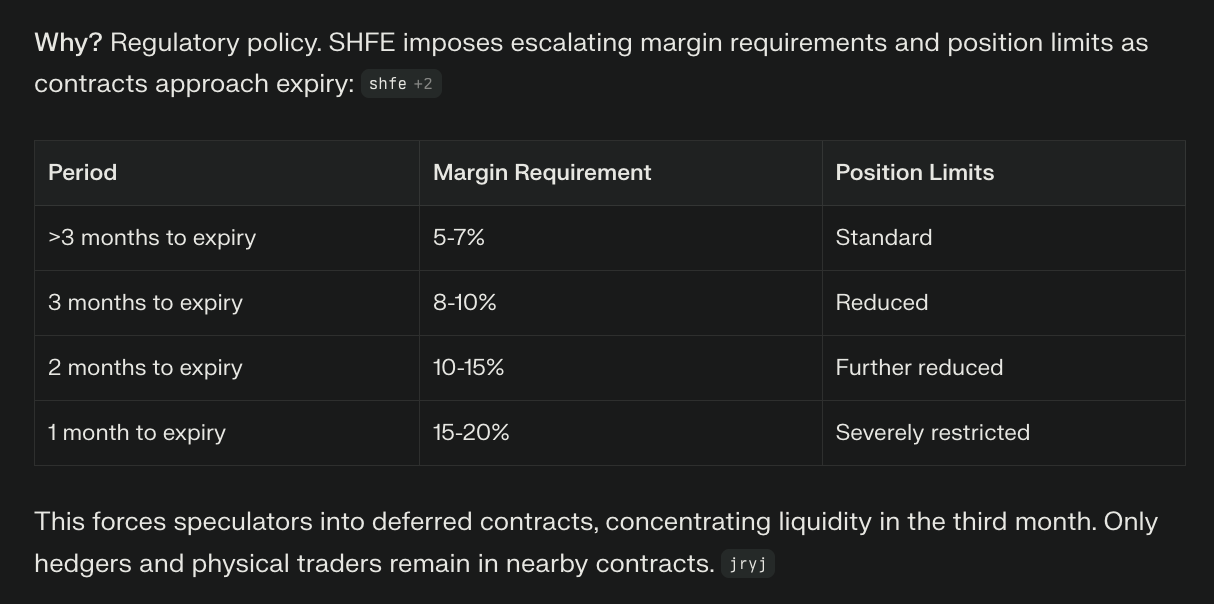
Margin Escalation
Western exchanges set position limits as a percentage of open interest without distinguishing speculators from hedgers.
SHFE escalates margin rapidly as expiry approaches.
Takeaway?
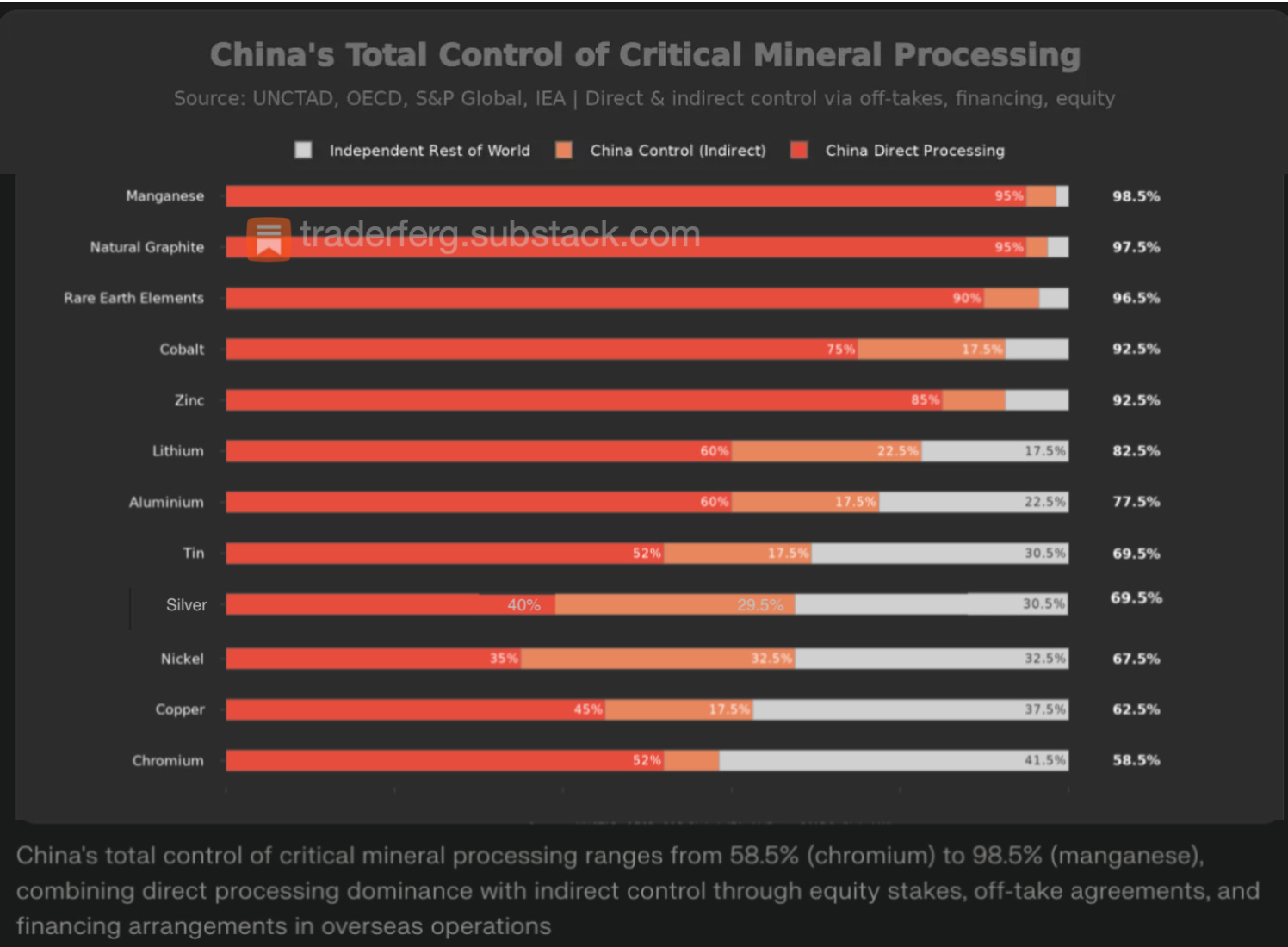
What if US dollars can no longer guarantee access to required processed commodities?
What if to guarantee access you need Yuan settlement and we are seeing the start of a new Petrodollar style system based around China’s monopoly of mineral processing?
I hope you’re all having a great week.
Cheers,
Ferg
P.S. I’m just finishing up my latest post on exchange operators, and feel countries will soon be faced with a choice.

Great work FERG ... you finding of late getting really washed out trading I've only been fulltime since early 22... but finding it hard to concentrate on trades ...bring on APRIL --- ST78
Thank you for introducing me to Craig Tindale's work. No one is writing about what he covers. The fact that all the intelligence agencies missed it or took no action is quite incredible. Comparable to thier failure to see the downfall of the Soviet Union or India's nuclear bomb.