I’ve always loved this example by Myrmikan Research; if all you knew were the gold price in Weimar marks, you’d be forgiven for thinking what a no-brainer trade gold was, and why not add leverage to it. Gold’s monthly percentage change tells the real story: the vast majority of market participants were chewed up and spat out trying to capture the obvious trade.

The past few months have felt similar, with a friend stating, “I’m always one Trump Tweet away from getting wrecked on any energy positions,” god forbid you use leverage (unless, you’re willing to pay Trump $100k/month for faster access).
It feels like a decent chunk of retail that invested/traded energy has thrown in the towel or, simply put, energy in the too-hard basket.
Markets love nothing more than to use a combination of volatility and time to wash the majority out, then make them chase, only to return to volatility and time to wash them out again.
“The main purpose of the stock market is to make fools of as many men as possible.”
-Bernard Baruch

The trading houses are like pigs in mud in this environment.
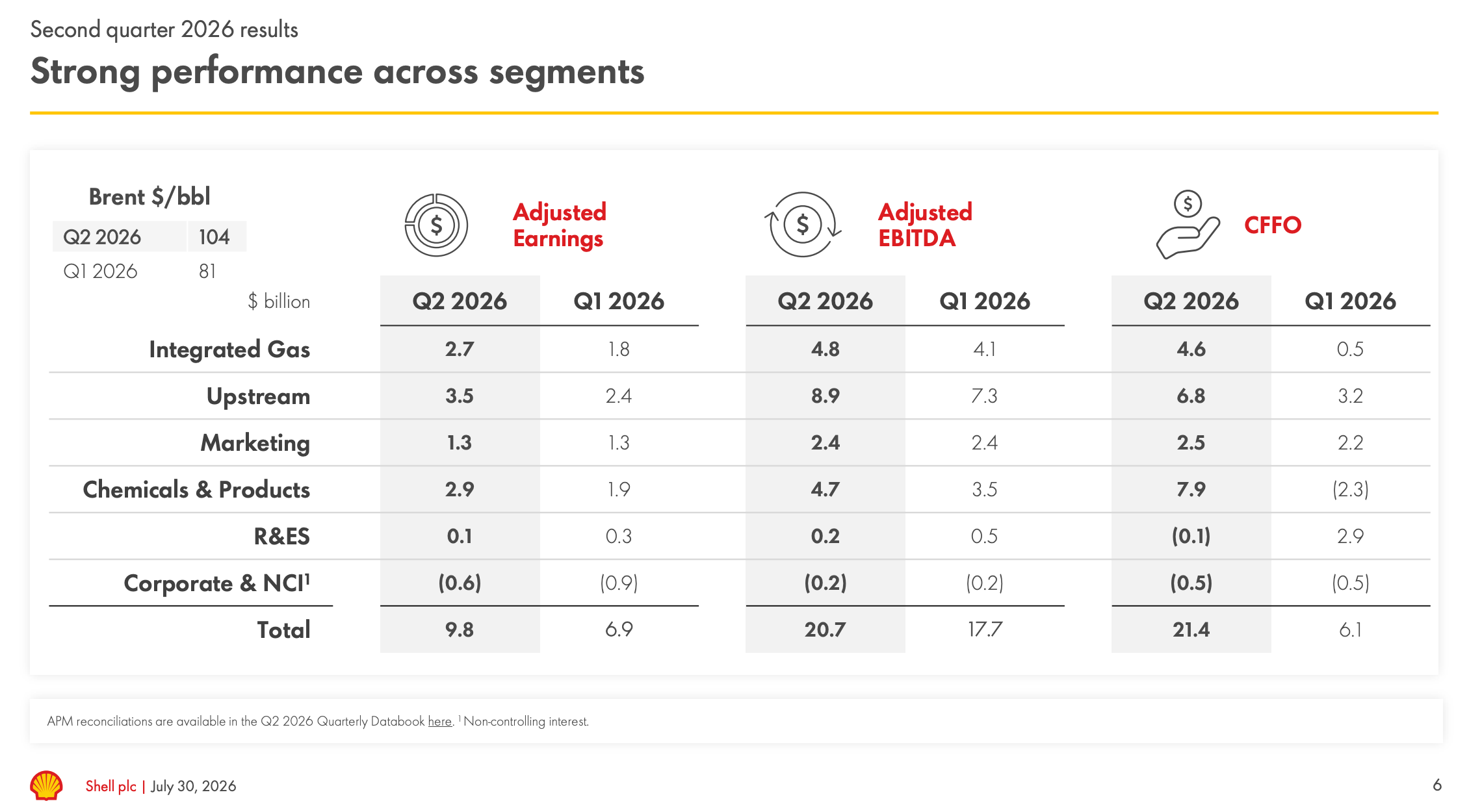
Shell posts best quarterly profit in four years as Iran war boosts oil and gas prices.
It marks Shell’s best quarterly result since the second quarter of 2022, when the company reported earnings of $11.47 billion as oil and gas prices surged in the wake of Russia’s full-scale invasion of Ukraine.
“Volatility is the new normal,” -Shell CEO Wael Sawan.
Shell is firing on all cylinders, with adjusted earnings up 50% on integrated gas, 42% on upstream, and 53% on products (with trading results mixed into the three…)
Glencore’s trading arm wasn’t far behind, hitting its annual target in the first half of the year.
Glencore Scores Huge Trading Profits as War Upends Markets
Based on its first-half performance, the company is already within touching distance of the top end of its annual earnings goal, which is set at $3.5 billion.
The trading business made $2.9 billion last year and a record haul of $6.4 billion in 2022 after Russia’s invasion of Ukraine. Still, the company gave no updated guidance on its full-year performance.

A big source of volatility coming down the pipeline.
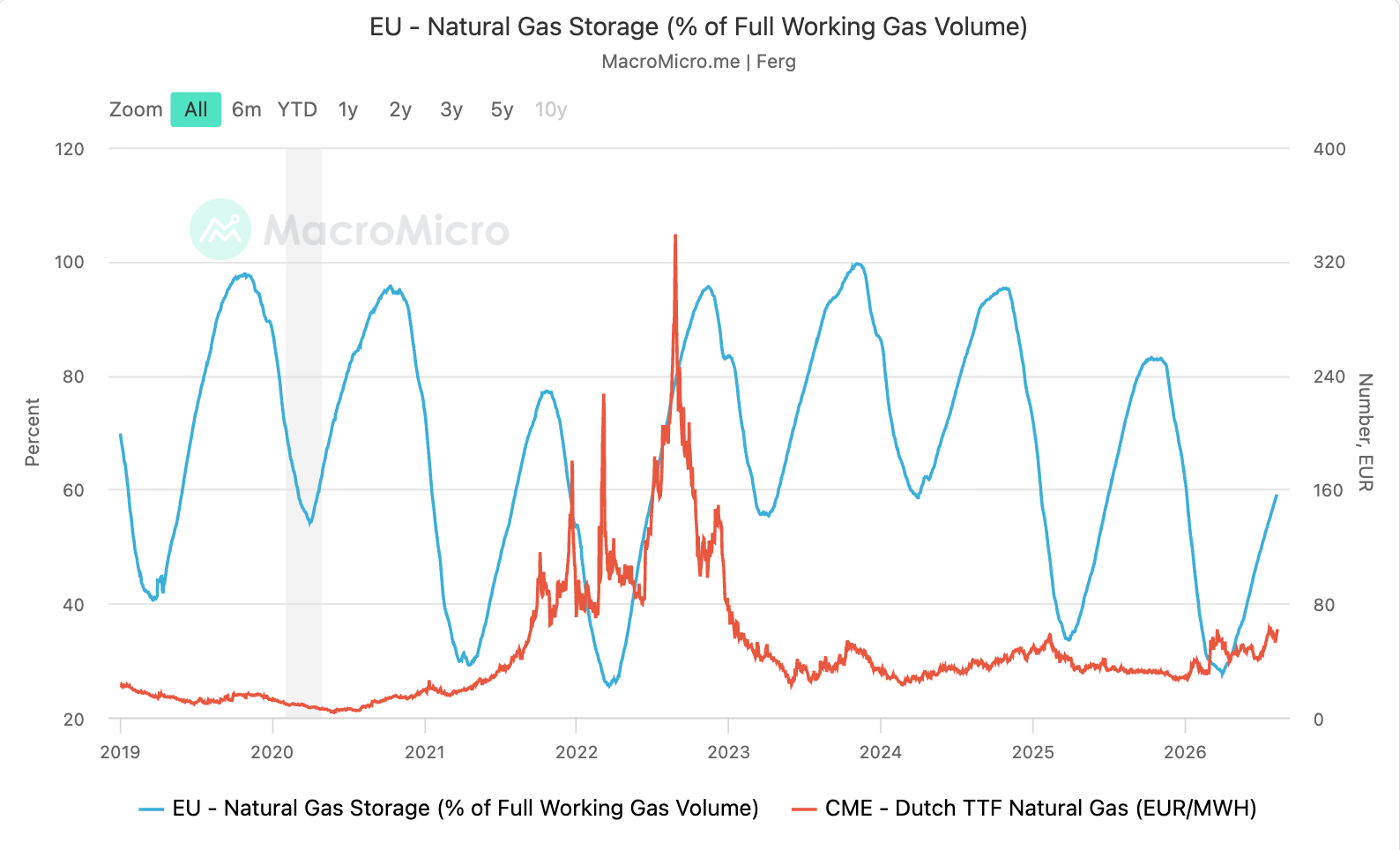
Yes, I’m a broken record on this, but the EU gas refill has now fallen off the lower bound of the past 10 years. It is decelerating every passing day, which is a big deal since historically July and August were months that pushed the most gas into EU storage.
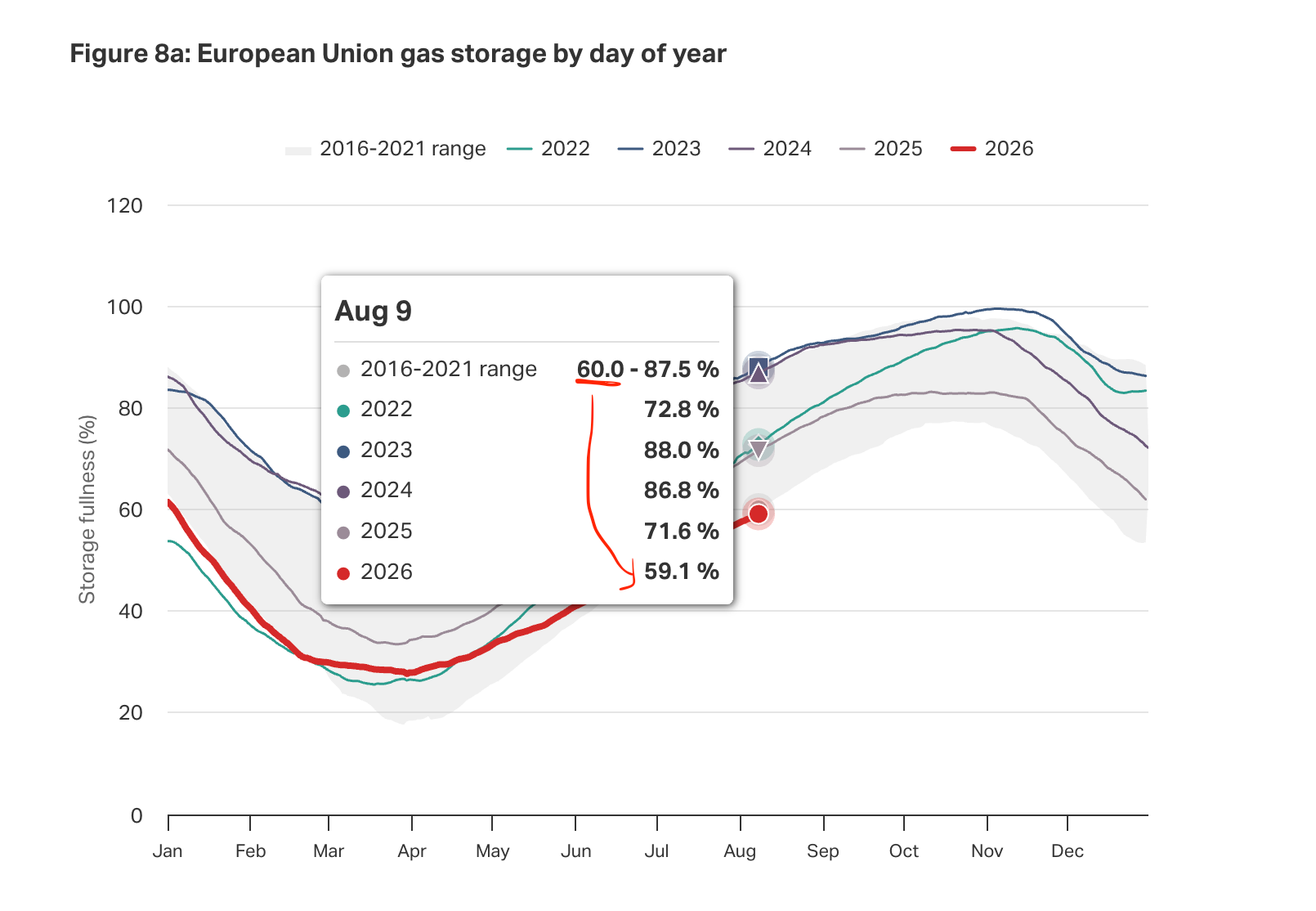
The two main factors causing this deceleration are:
Asian buyers being forced to replace Qatari volumes with Force Majeure extended to October, which I’ll go over.
Storage displacement: The EU heatwave has ramped cooling demand combined with weak hydro and nuclear (France Shuts Off More Nuclear Power as Heat Builds Across Europe) pushed more gas into power generation, reducing volumes available for injection.
It’ll be fine arguments…
The most convincing counterargument (other than hoping for a mild winter) I’ve come across is the one presented below: EU gas demand is down ~18% over the last 5 years, so you don’t need the same level of storage.
On the surface, this sounds logical if you ignore how the energy mix has changed and what makes up that -18% demand reduction.

Flaws I see with this argument.
That -18% demand figure
That 18% reduction in demand is roughly half industrial demand destruction (plus renewable switching) and half household demand reduction, which is highly dependent on winter temperature, i.e that reduction will disappear in a cold winter (>60% of winter gas consumption derives from households, and peak winter consumption can be 2x real-time supply for short periods, hence why storage draws are essential!)
The energy mix has changed
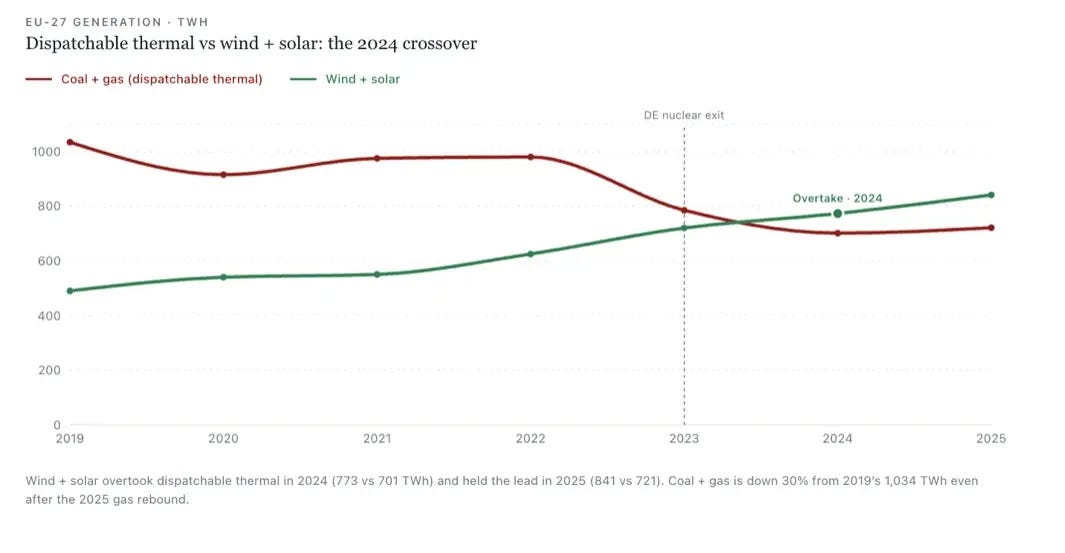
The EU energy mix has changed over this period with the removal of 210TWH of coal generation (36% German), 65TWH of nuclear generation (100% German), -21GW coal capacity (48% German), and the loss of 134 bcm of Russian Gas. In the additions column, you have +244 TWH of solar and +107 TWH of wind generation (of which solar doesn’t show up in the winter and can experience Dunkelflaute, i.e. wind droughts).
Or to visualise it, you are comparing that higher plateau of dispatchable base load (2019-2022) to a new weather-dependent system.
It’s not only the baseload resiliency that’s been slipping over time; the last time gas storage was 100% heading into winter 2023, winter 2024 was 95%, 2025 winter was 82%, and this winter looks on a 70-73% trajectory.
Only an EU Bureaucrat could fail to understand that when you remove gas pipelines, reactors and coal plants, which all provide winter baseload, and replace them with solar, which goes on leave during the coldest winter months, you are left with a system reliant on wind, LNG imports, gas storage, cross-border electricity imports and woollen blankets…

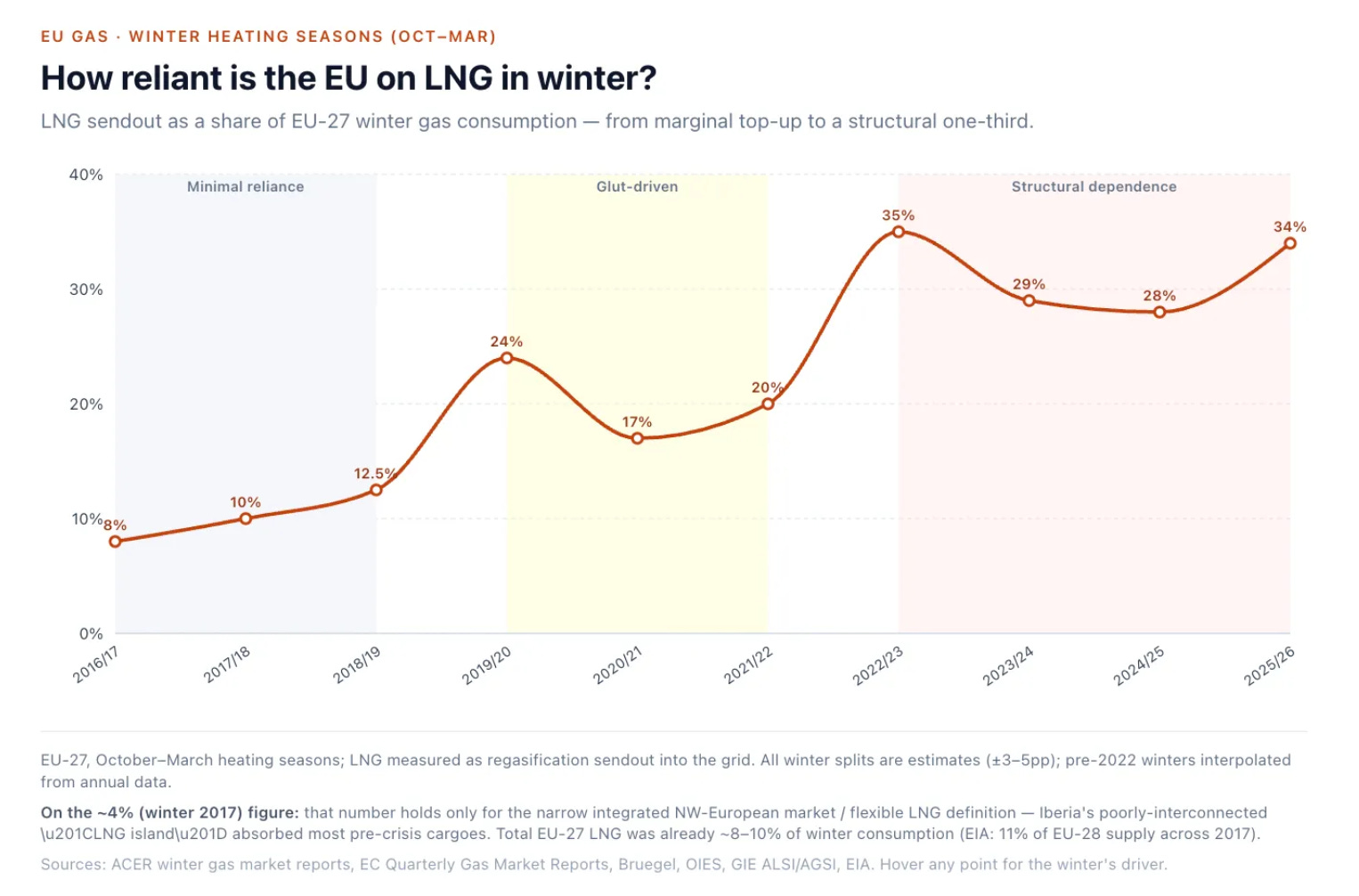
LNG as a % of winter heating demand
This brings me to the key flaw in the earlier Tweet: comparing an energy system that used to be reliant on 12.5% LNG consumption in the winter to one that can now exceed a third of winter demand is obviously a recipe for disaster.
The problem with averages
Lastly, using an average conceals the extremes, or to illustrate via a banger from Howard Marks:
“Never forget the six-foot-tall man who drowned crossing the stream that was five feet deep on average.”
Energy systems should be designed around resilience, and plan for the worst thing that can happen to ensure the system can handle it. What the EU and, in particular, Germany has is a system that hopes for the best. As if you have a cold winter, a wind drought, little to no solar, and low gas storage, you are the 10-foot hole in the middle of Mark’s river…
Germany is the one to watch.
Talking of averages, the vast majority of European countries have sufficient gas storage; it’s just Germany, the Netherlands, and Belgium that are in deep shit here.
Germany is the EU’s largest gas consumer at ~24%, and more than half of winter consumption must be via storage withdrawals and LNG imports…
Germany is also the EU’s largest coal consumer (51% lignite +49% hard coal) at roughly a third of EU consumption, which is facing constraints with low river levels: Rhine River Shipping Stalls as Water Level Hits Record Low, which directly impacts the hard coal plants, which are barge-dependent (Lignite plants are unaffected due to being at mine mouth).
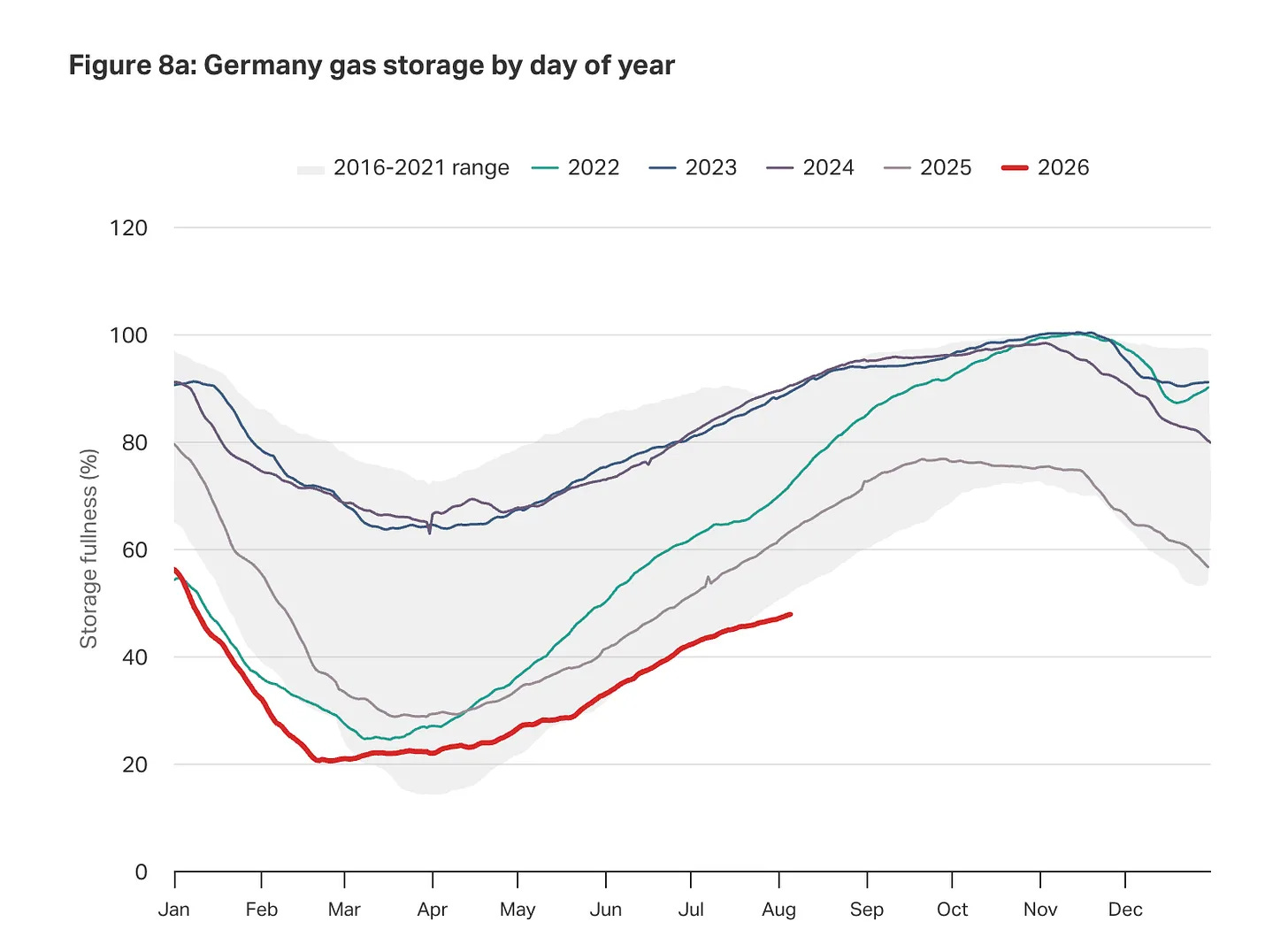
Storage is no longer a winter cushion; it’s essential for Germany, yet they are tracking a full -4.5% below the 10-year historic low and slowing.