Optimising for efficiency is rational; if something can be done cheaper and better, you outsource it. There is often a trade-off in reduced resiliency, but it’s gradual, and if you don’t do it, someone else will put you out of business.
“Just in time supply chains” were one big momentum trade until they ran into a situation that reinforced the need for “just in case”.
COVID was the first event to illustrate the fragility of global supply chains; then came Chinese import restrictions on critical minerals; and now we are in the midst of a shock to just-in-time energy, fertiliser and chemicals.
Some countries didn’t even trade their energy resiliency for efficiency…. they traded it for nothing at all.
Exhibit A
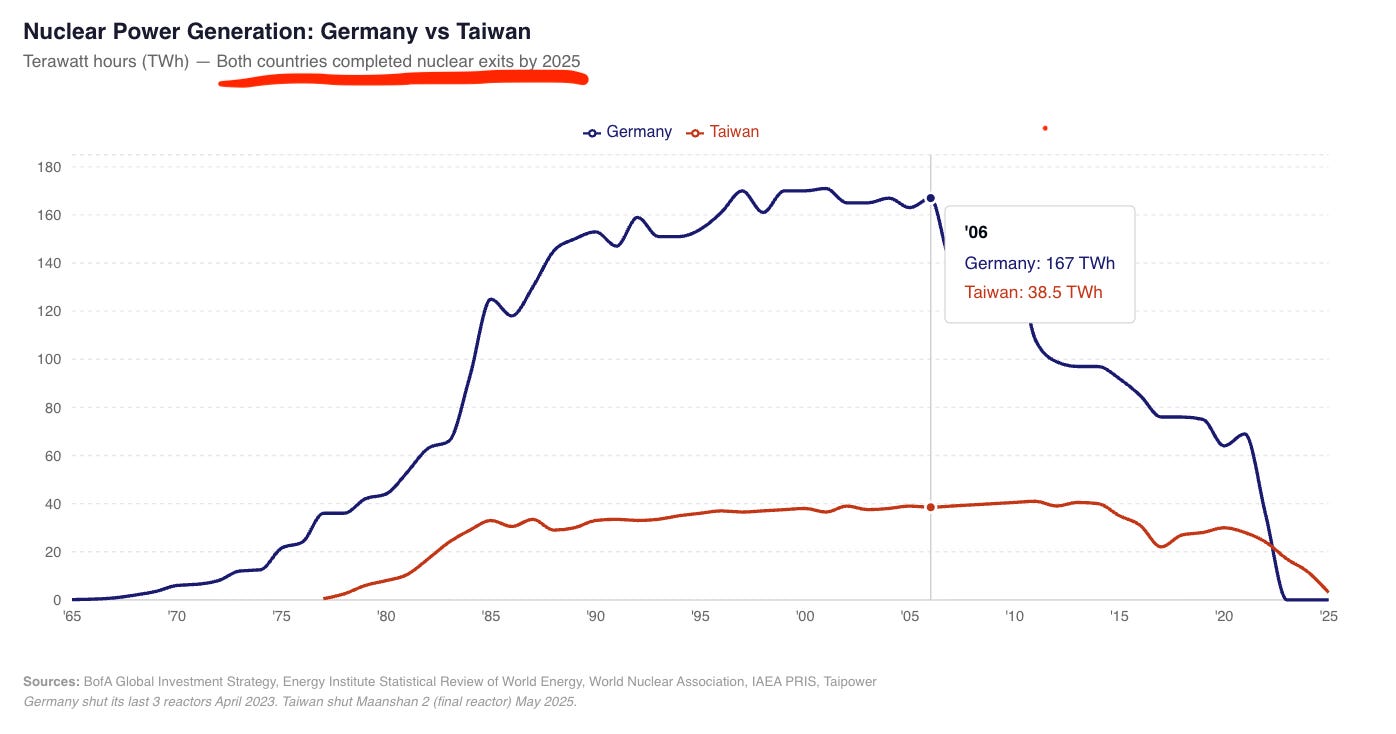
Yes, Taiwan are reversing it less than a year later: In Major Reversal, Taiwan Seeks To Rewire Its Energy Strategy by Restarting its Nuclear Plants.
Germany has been busy destroying its energy resiliency for a decade now, and not even the 2022 energy crisis forced it to rethink its energy policy (exiting nuclear before lignite coal plants is peak ideology/stupidity).
To illustrate:
At one point, Germany was the largest electricity exporter in Europe (now a net importer).
Germany added 29% to gross capacity, while generation has collapsed by 23% since 2017.
Germany has one of, if not the most expensive, electricity prices among major economies globally.
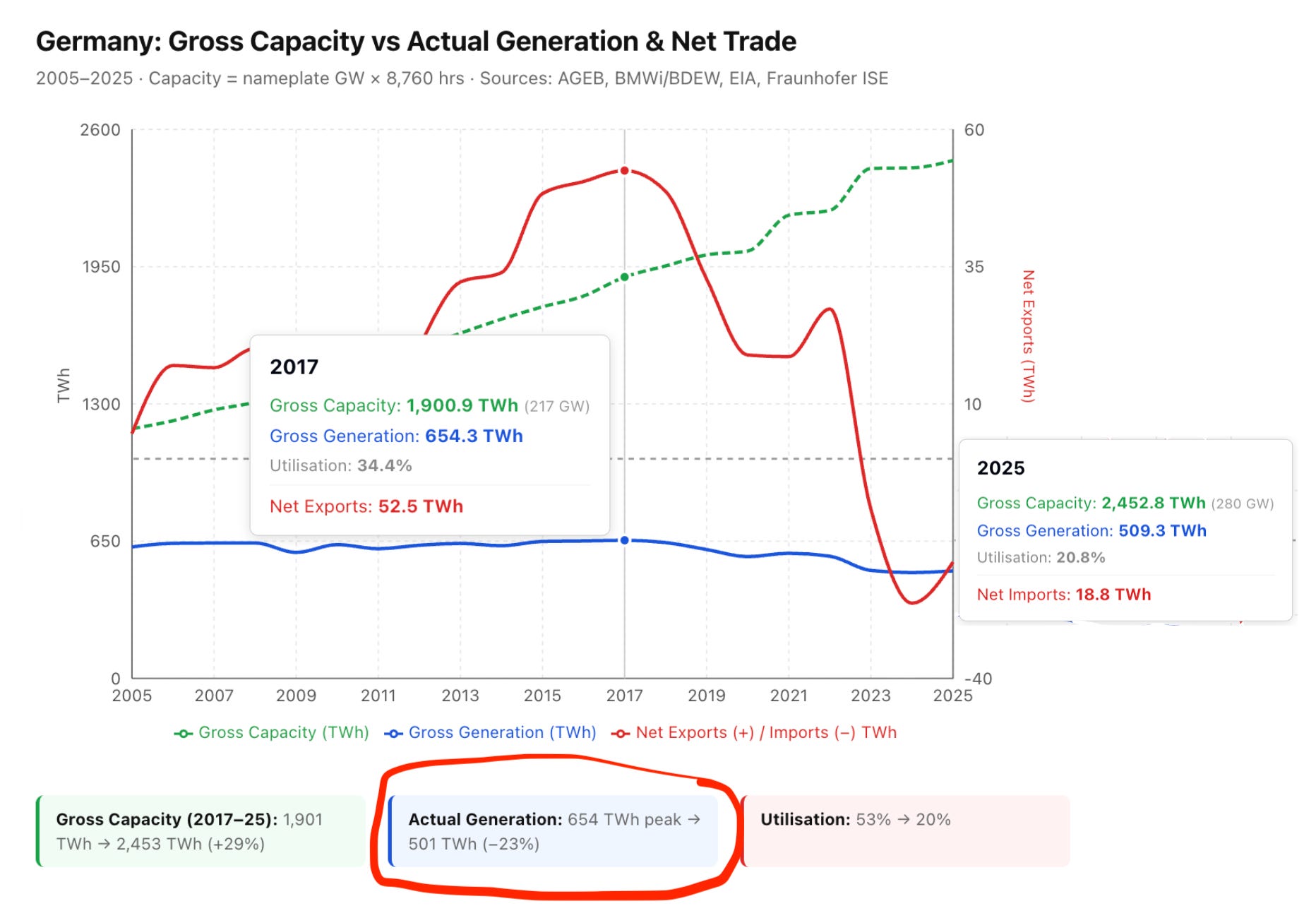
“Engineering a slow-motion reliability crisis”
The first person I heard outline the fragility of over-dependence on intermittent renewables with just-in-time natural gas was Meredith Angwin (who wrote “Shorting the Grid”).
While Meredith was analysing the US grid, and in particular New England, I’ve seen a parallel emerging with LNG and the growth in destination flexibility driven by the US LNG expansion.
Destination-flexible LNG has reached approximately ~48% of global trade, driven by the tripling of US export capacity and the rise of portfolio players (large IOCs and a few NOCs) who intermediate 45–55% of global flows.
Just in time LNG? If you pay up, that is…
Players buy on long-term contracts (15–27 years, needed to underwrite liquefaction project finance) and resell on shorter, more flexible terms.
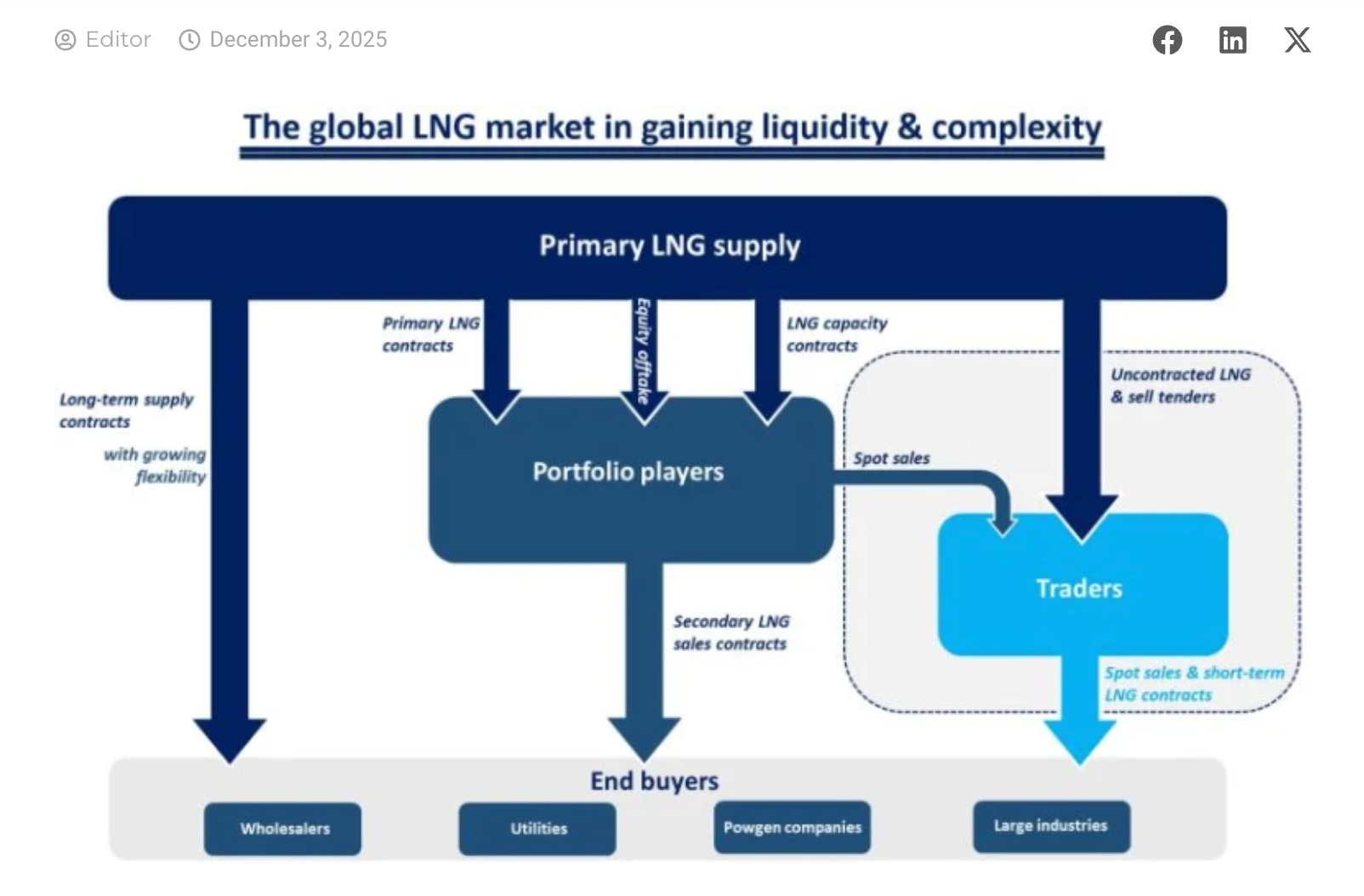
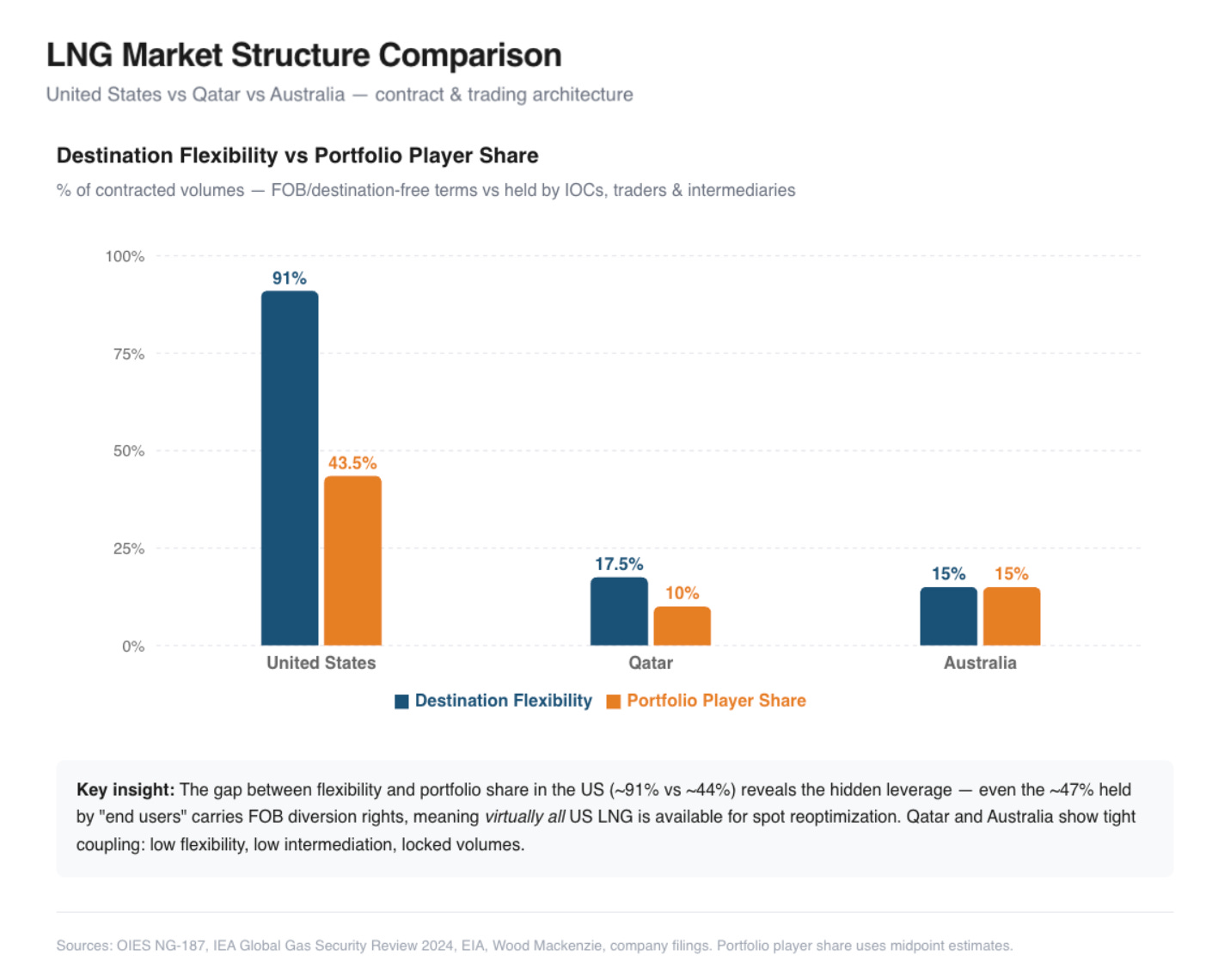
US LNG goes to the highest bidder; 91% of US LNG sales and purchase agreements are structured on FOB terms, meaning the buyer takes title at the loading terminal on the US Gulf Coast and controls where the ship goes.
Qatar and Australia have strict destination clauses that prohibit resale or rerouting and lock LNG into predetermined routes regardless of where the highest price exists (providing security of supply to the end user), while leaving a smaller proportion for spot/destination flexibility.
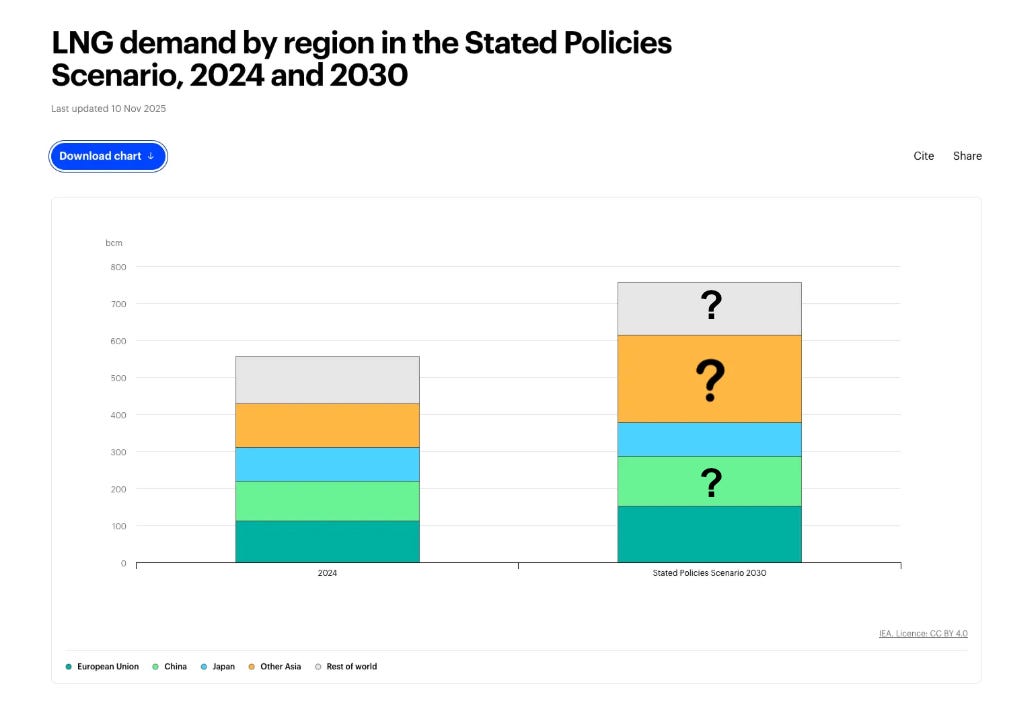
Asia is forecast to drive LNG demand
”The Asia Pacific region accounts for almost 80% of this gas additional demand out to 2030”. -IEA Gas 2025
If LNG remains structurally tight, what happens to Asian demand since LNG is a marginal luxury for most of Asia?
Yes, wealthy Asians with contracted volumes like Japan, Taiwan and South Korea will pay up, but the rest won’t.
Pakistan, Bangladesh, and India exit spot markets first and pivot to coal.
China pivots to domestic gas, pipelines, and coal (ramps up coal utilisation).
Japan, Taiwan and Korea absorb losses through contracted volumes.
Add to this dynamic the fact that a number of Asian countries are heavily subsidising LNG, with the expectation that prices will converge closer to coal pricing on the back of the massive LNG build-out and glut forecasts.
It’s already unsustainable for poorer Asian countries at $12/MMBtu, let alone when JKM heads towards $20/MMBtu!
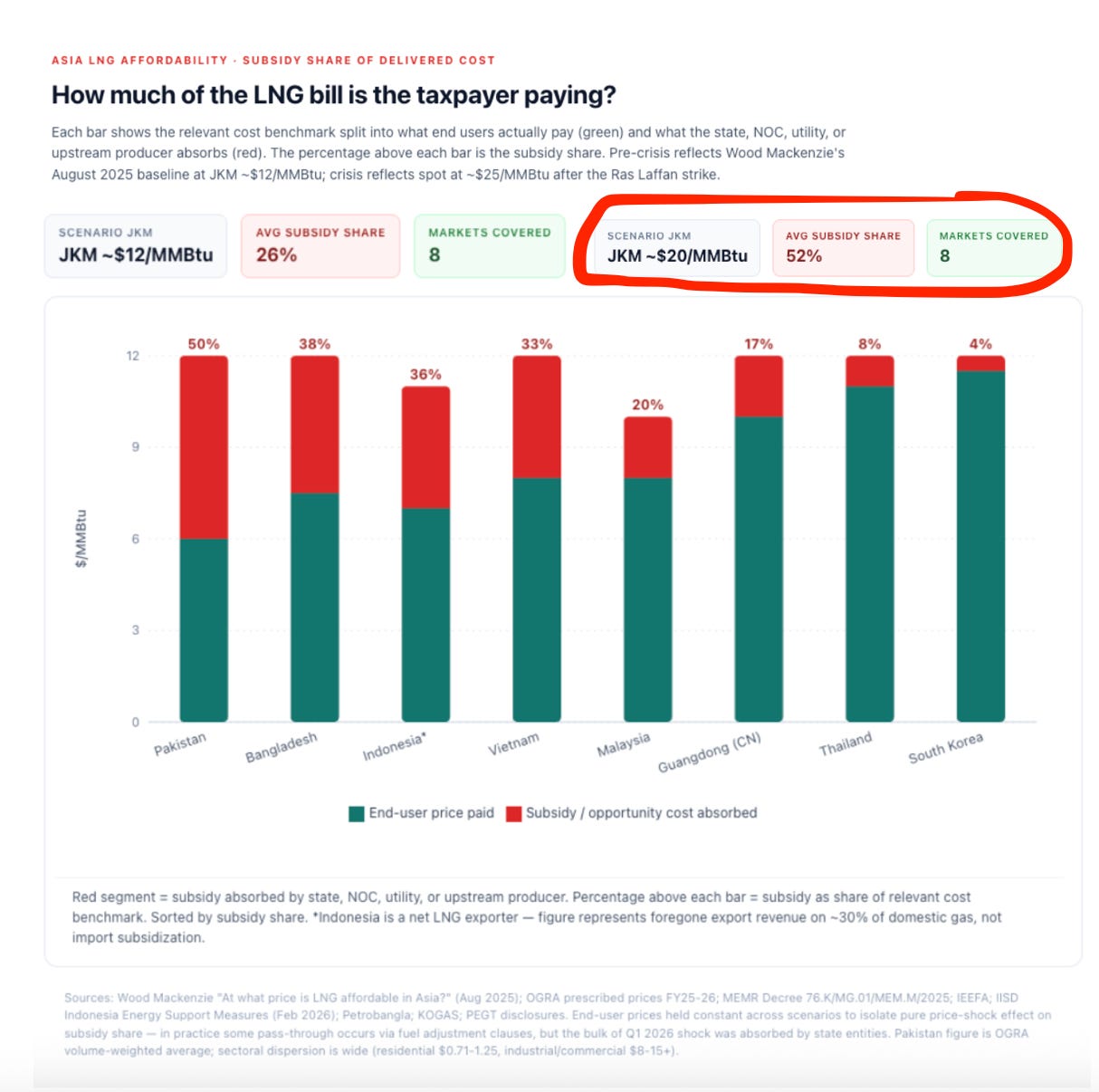
For example, Bangladesh spent more than half its full-year subsidy allocation in April…
Officials say the state-run Petrobangla has placed the subsidy demand with the Ministry of Finance (MoF), as global fuel prices spike and reserves a limited.
The April subsidy amount, as sought by the corporation, is more than 50 per cent of the entire subsidy amount worth Tk 89 billion it got from the MoF in the previous fiscal year (FY) 2024-2025.
While Pakistan Faces Extensive Blackouts as Gas Shortfall Worsens.
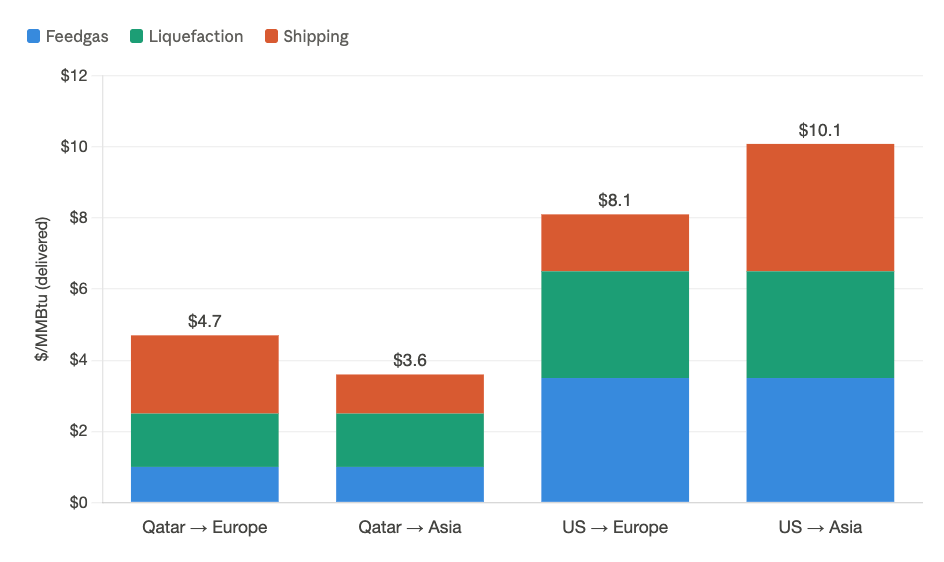
Qatar sits at the bottom of the LNG cost curve.
US LNG cannot replicate Qatar’s cost advantage (delivered costs 2–3x higher than Qatar’s breakeven), so it can’t ever compete with Asian coal.
The geographic penalty to Asia is real and permanent. US-to-Asia shipping takes nearly twice as long as Qatar-to-Asia shipping, tying up more tonnage and adding $2–3/MMBtu in freight costs. The US structural advantage lies in European markets.
The crisis has created a two-tier buyer landscape. European and Wealthy Asian buyers with pre-existing US contracts, while the rest get priced out.
Consequences?
I’m going to skip the geopolitics insights as I don’t have any.
Your guess on how this goat rodeo of a (US only?) ceasefire blockade is going to evolve is as good as mine.

LNG (and fertiliser) are the easier elements of this whole debacle to understand since there is no bypass ability, unlike oil (and marginal SPR or dark fleet to unsanction…)
What we know.
Not a single (loaded) LNG carrier has transited the strait (fertiliser is similar).
Ras Laffan (20% of the world’s LNG) is offline (with two trains currently being restarted).
17% of Ras Laffan’s capacity is now destroyed
Ras Laffan NFE is delayed (again).
Euro gas storage concerns (with no urgency to rectify).
The Big Switch
Not a single (loaded) LNG carrier has transited the strait to date.
We have yet to see a single loaded LNG carrier (an empty one did) transit the Strait, while Iran has halted two Qatar LNG tankers it previously cleared to transit. These were bound for China and Pakistan, which makes their being turned back a head-scratcher.

Approximately 4 empty LNG carriers and 15 laden ones remain stranded inside the Gulf as of April 9, 2026, according to Kpler vessel-tracking data (with 50 Qatari LNG tankers sitting idle across Asia).
A lot of what I’m going to describe in this piece will start from the point those 15 laden LNG carriers start transiting; everything else is noise.
Iran has almost entirely shut out vessels owned by the UAE, Qatar, Saudi Arabia, and Kuwait since February 28, 2026 (Yes, ADNOC managed two dark transits with AIS transponders switched off). They aren’t going to legitimise the toll, and there is zero chance Qatar takes any risks with its LNG carriers as they are extraordinarily valuable ($250 million per vessel, $100-200 million per cargo). The Qatari Q-Max and Q-Flex fleet is effectively irreplaceable on any reasonable timeline (which makes them pretty much uninsurable at any rational premium).
Not that this matters much currently with the blockade!
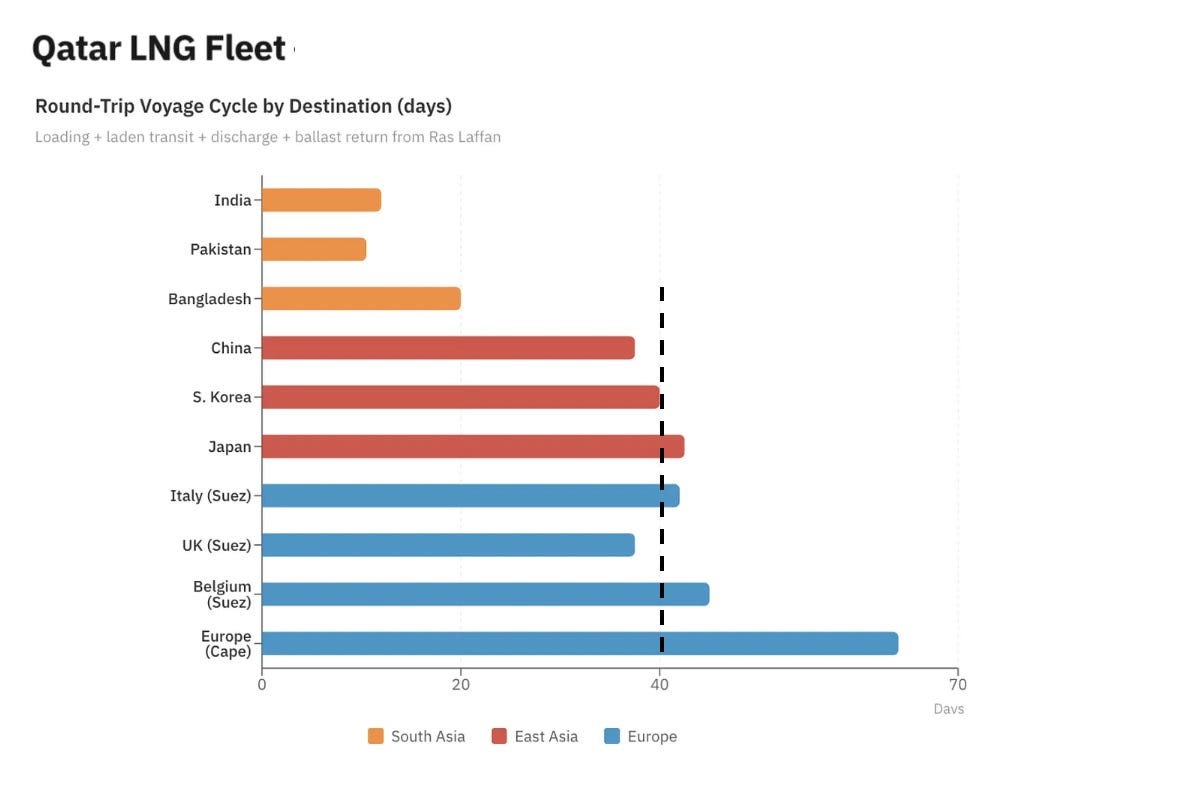
The distance they have to cover to the likes of China, South Korea, Japan and Europe creates a further lag of ~40days when they get moving again.
Fertiliser is in a similar position.
41 vessels carrying approximately 1.9 million tonnes of fertilisers are currently trapped behind the strait. Only 5–6 fertiliser vessels total have exited the Gulf since the war began on February 28, and none since March 22.
Similar to the 15 LNG carriers, all eyes are on when these fertiliser vessels will transit and reach their destinations in time for various planting seasons.
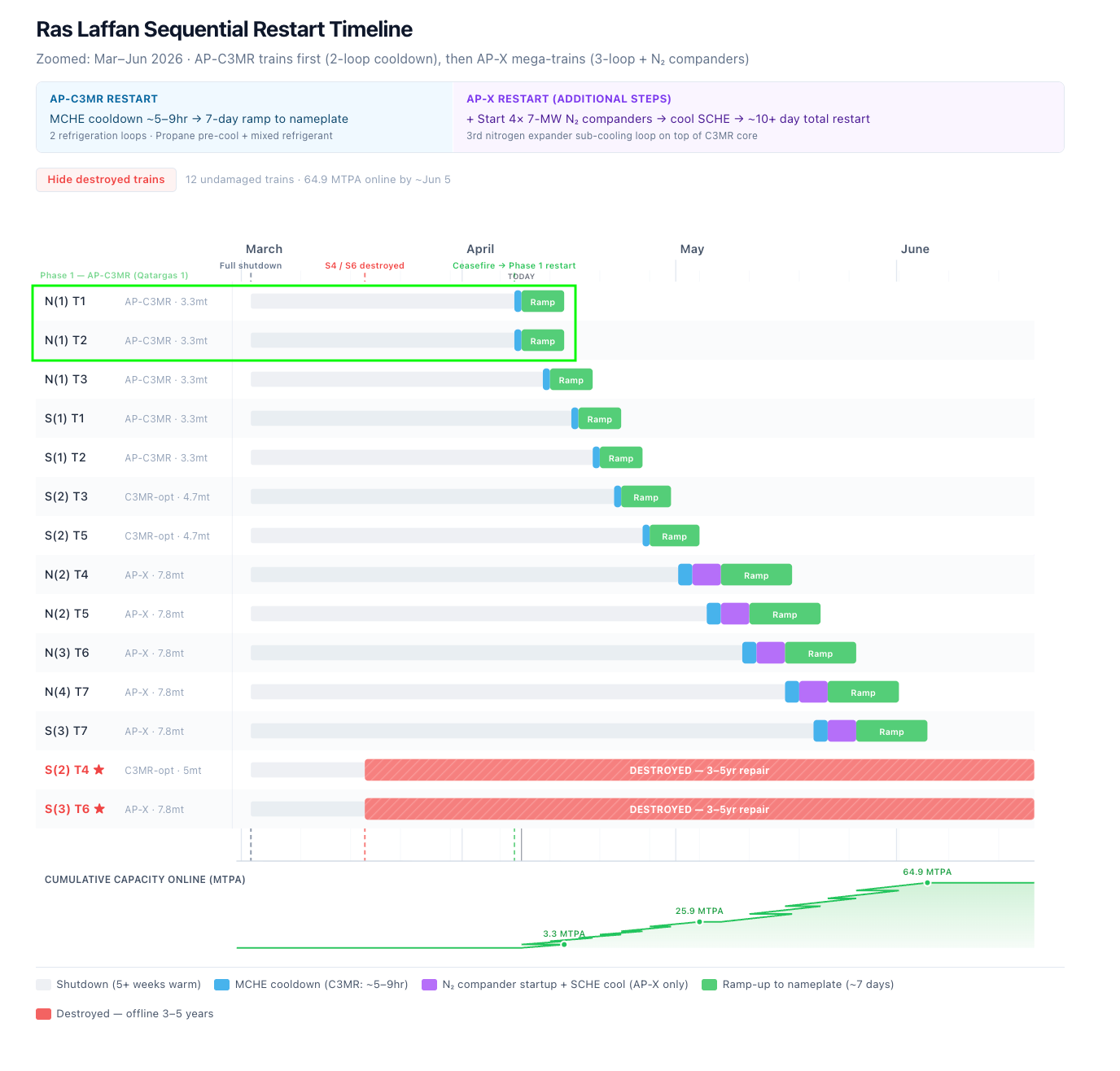
Ras Laffan (20% of the world’s LNG) will take 4-6 weeks to fully restart
QatarEnergy prepares to resume LNG output after March attacks
Two of the three trains at QELNG North 1 (Qatargas-1), Qatar’s initial LNG project located in Ras Laffan Industrial City, have been reactivated. This facility encompasses three liquefaction trains with a total capacity of around ten million tonnes per annum (mtpa).
If the sequential restart were to go perfectly from 9th April, we would still be looking at early June for all the operating LNG trains to be online.
Why sequential restarts?
Each LNG train needs enormous power (35–85 MW per compressor string), so starting multiple trains at once would overwhelm the facility’s electrical system with surge currents and voltage instability. An 18 MTPA facility draws around 800 MW at full capacity. Beyond power, trains share infrastructure, boil-off gas compressors, refrigerant systems, and gas pretreatment units, which simply can’t serve multiple startups simultaneously. So trains must come back one at a time.
Without safe tanker passage through the Strait of Hormuz, restarted trains must be shut down again, as there are only 4 empty LNG carriers plus the storage tanks to fill.
To top things off, Cyclone Narelle knocked 30+ mtpa of Australian LNG offline, which was quite some timing!
By April 9, Wheatstone’s Train 1 had returned to full LNG production rates, bringing the facility to 50% capacity. However, Train 2 requires replacement of the damaged fin-fan coolers, a process expected to extend into late April or possibly early May.
So, with Train 2 still down, roughly 1.0% of global LNG trade remains offline for another few weeks.
17% of Ras Laffan’s capacity is now destroyed
Pretty self-explanatory…
Saad al-Kaabi said two of Qatar’s 14 LNG trains and one of its two gas-to-liquids (GTL) facilities were damaged in the unprecedented strikes. The repairs will sideline 12.8 million tons per year of LNG for three to five years, he said in an interview.
This was an insightful overview from someone deep in the weeds with LNG trains.
Ultra high-res imagery of the Ras Laffan LNG South Complex from Mar 22.
It’s also not as if Honeywell has a whole lot of spare capacity currently, with a full order-book out to 2028.
Honeywell's company-wide backlog hit a record $37 billion at end of 2025, with its Energy and Sustainability Solutions segment showing double-digit order growth. The company has acknowledged in investor materials that "growth is constrained by production capacity" and that LNG bookings extend into 2028. sec
Ras Laffan NFE delayed again…
Qatar first unveiled the NFE expansion in 2018. The plan was to build four 8‑mtpa LNG trains and bring them online sequentially starting in 2023, with a new train every six months. COVID pushed out that timeframe, with it being extended by an additional quarter, the last few quarters, with the first LNG trains 85% complete.
The timeframes kept slipping before the war broke out, with the below from February 9th 2026.
Qatar Pushes Start of Its Massive LNG Expansion to End-2026
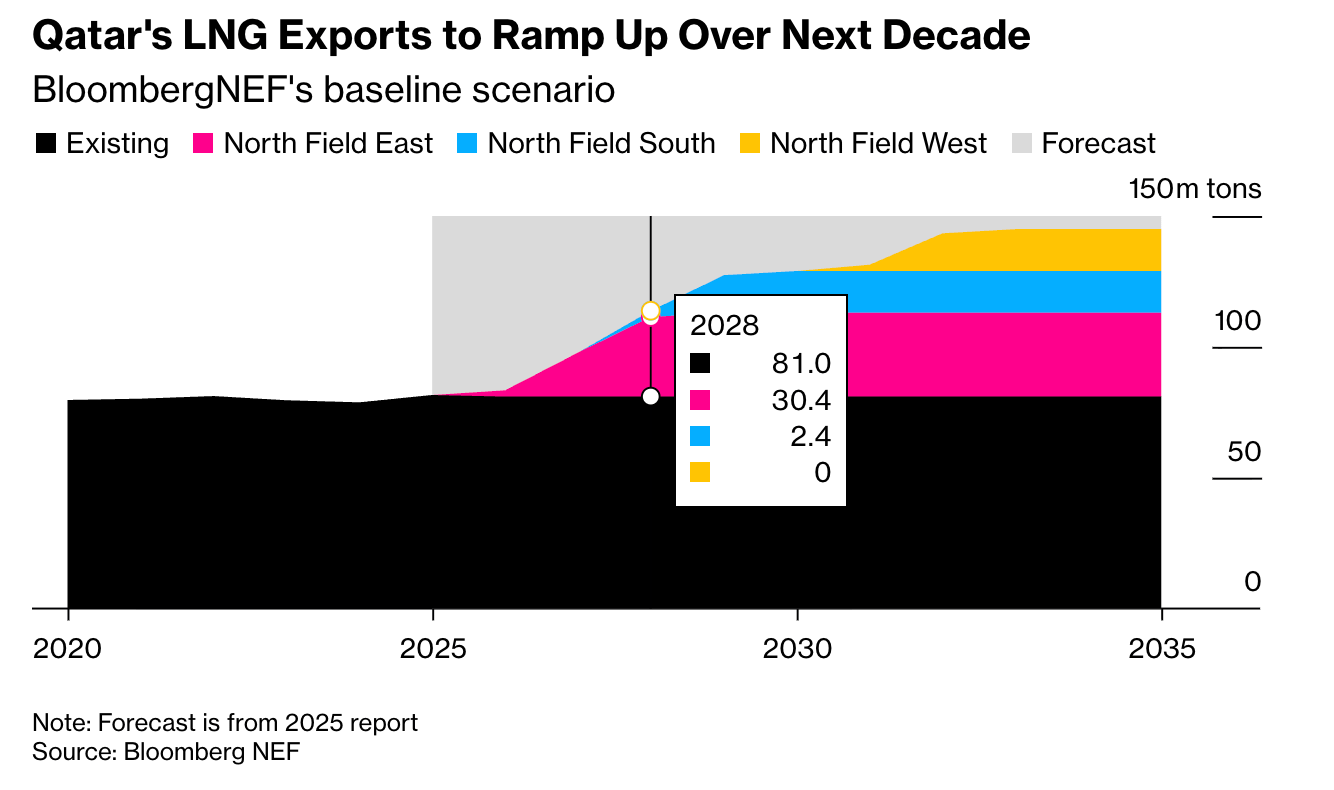
North Field East (NFE): Four new AP-X mega-trains, adding 32 MTPA, were originally targeted for late 2026 startup, which was already pushed to Q4 2026 before the war.
Qatar Said to Push LNG Expansion to 2027 After Iran Drone Attack
In a similar way to LNG train restarts, NFE delays will undoubtedly shuffle back NFS and NFW expansions.
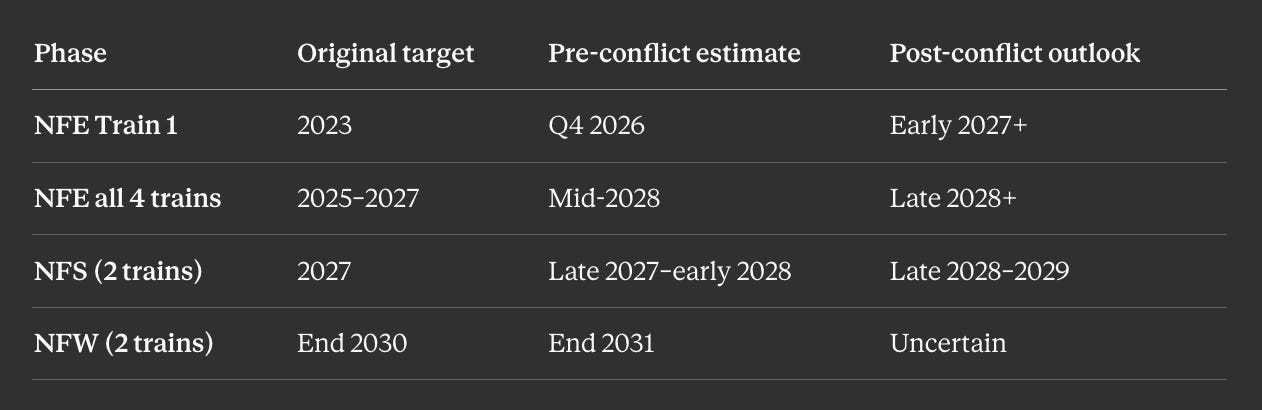
NFE and NFS provided energy security to countries via long-term destination fixed contracts.
However, a notable counter-trend has emerged since 2023. The IEA reports that more than 70% of newly contracted LNG volumes since 2023 are destination-fixed, with 85% carrying durations of 10+ years. This reversal is concentrated in Qatar’s massive North Field expansion: 7-year deals with Sinopec, Shell, TotalEnergies, Eni, and CNPC that are predominantly destination-restricted and oil-indexed. The post-2022 supply security panic restored seller leverage for traditional structures.
Euro Gas Storage Concerns
The 2025/26 winter laid bare the intermittency risks embedded in Europe's energy transition. A historic wind drought through the first half of 2025, a November Dunkelflaute episode, collapsing Nordic hydro reserves, and surging gas-for-power demand combined to push gas storage to record lows by March 2026
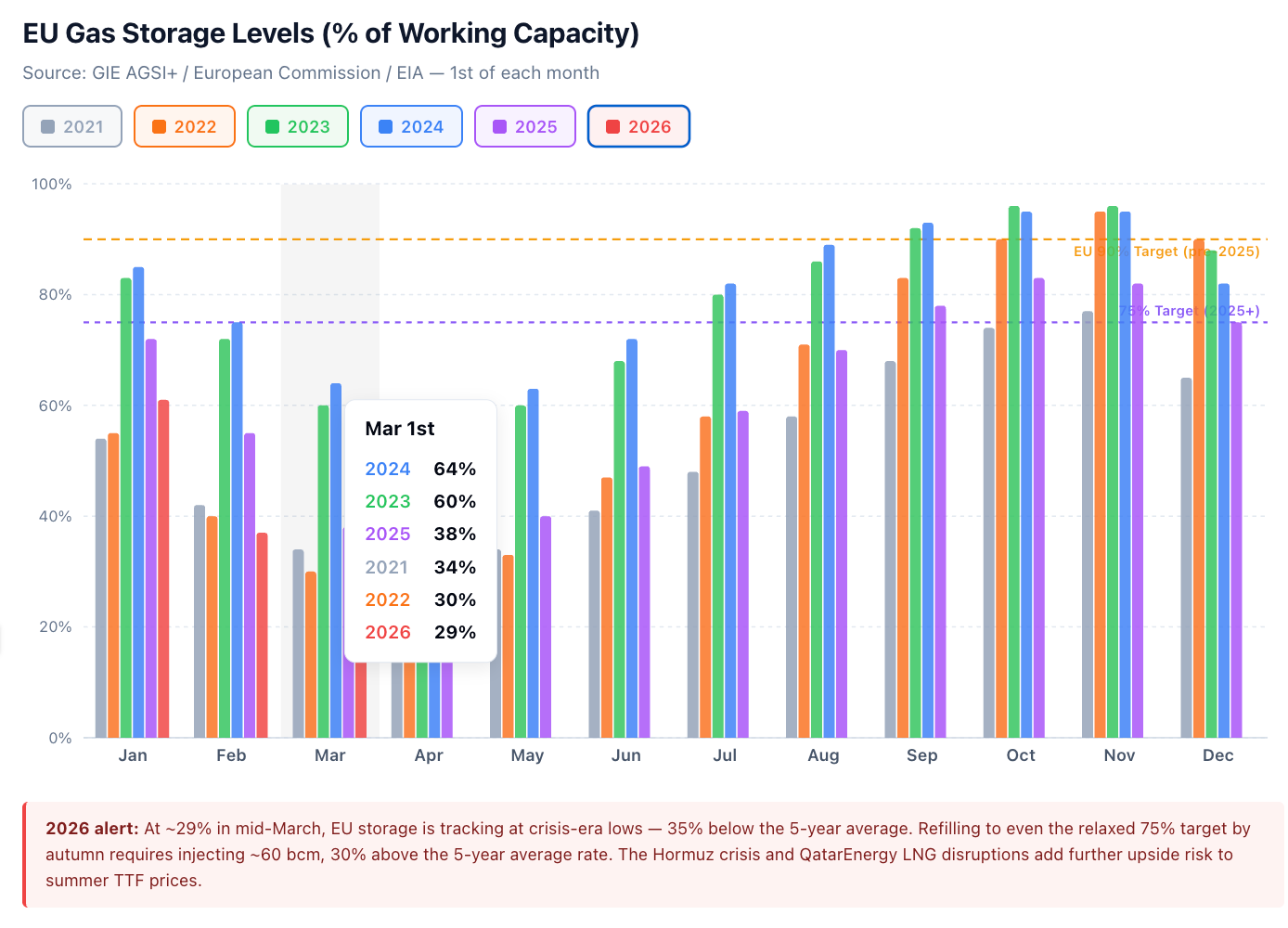
Interestingly, there doesn’t seem to be any urgency to rectify this with the view that this is a short-term disruption.
This feels a bit premature, and Javier points to TTF pulling back as proof that things are fine.

In 2022, TTF spiked to $222MMbtu in February before pulling all the way back to $78MMbtu in June, then hitting a peak of $340MMbtu in August.
I’m seeing a similar dynamic to what happened in 2022, with storage operators again refusing to inject gas because backwardated forward curves guarantee losses.
While I don’t think this will be anywhere near as severe as 2022, the European complacency is quite something, especially if they end up with a cold winter or another “wind drought”.
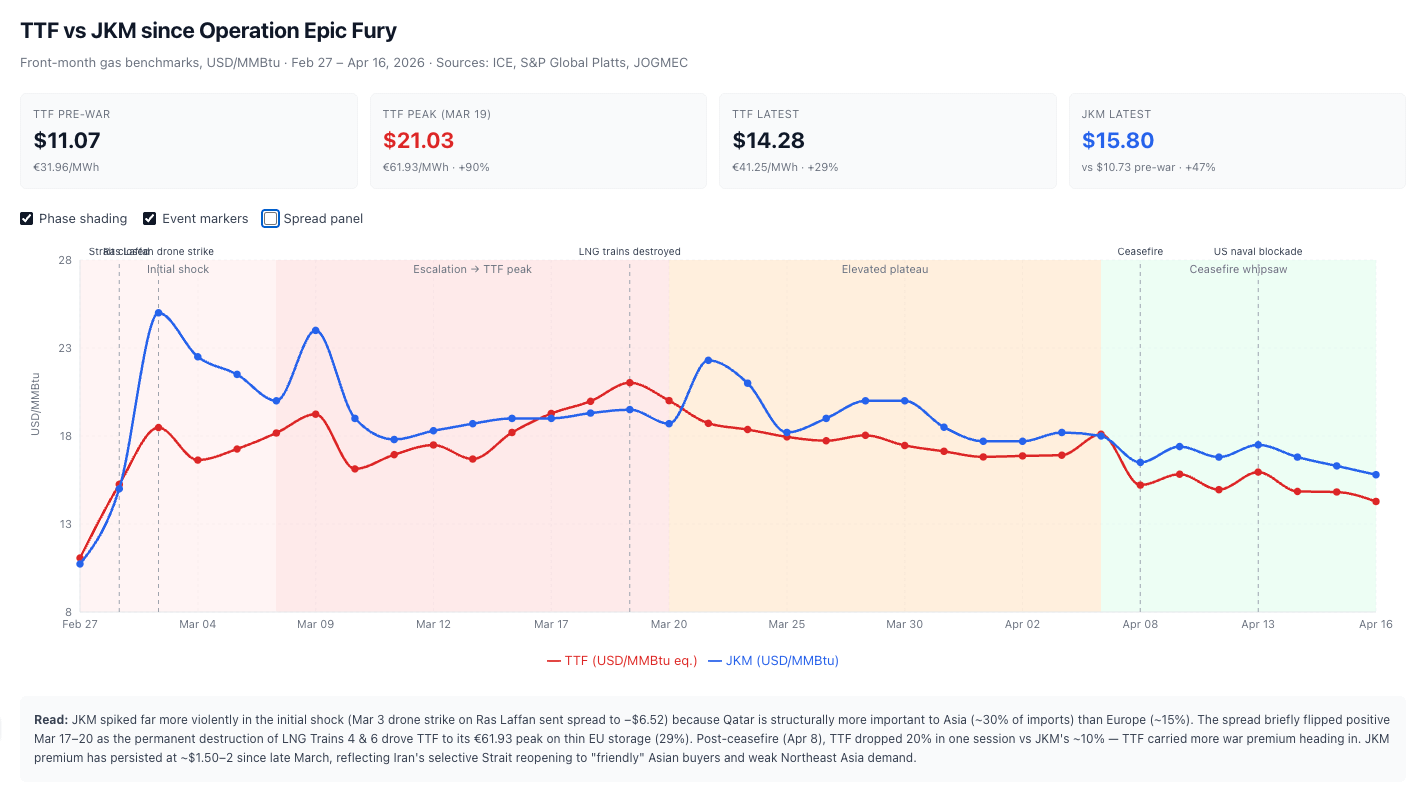
Europe loses its grip as LNG cargoes chase higher prices in Asia
Since the outbreak of the Middle East war on February 28, the number of diverted LNG tankers has continued to grow, with the last Qatari cargoes expected to arrive in the UK and Italy by 27 March, according to data from the intelligence firm Kpler.
“We have 11 LNG cargoes that have been confirmed as diverted from Europe to Asia, plus two that have been diverted from Europe to Egypt and one from Europe to Turkey,” Laura Page, Insight manager LNG & Natural Gas at Kpler, told Euronews.
This chart reminds me of the constant premium we see in Shanghai for silver and gold.
The reluctance to refill gas storage is an EU-wide phenomenon, not a German anomaly, given the likes of Portugal, Spain and Poland are fine.
Dutch gas storage levels hit lowest level in years
"Current prices do not make it obvious that companies will start buying gas in time," Gasunie said, as high prices make it unattractive to buy gas and then store it.
Gas Importer VNG Urges Germany to Intervene to Refill Storage
“As a result, we will only start buying once these spreads have shifted back in a direction that makes economic sense for us,” Heitmüller said. VNG imports gas and is the third-largest gas storage operator in Germany.
At a meeting of European energy ministers this week, a group of nations including Germany, the Netherlands and the Nordics urged the EU to refrain from stepping into the market when reacting to the war-related price shocks.
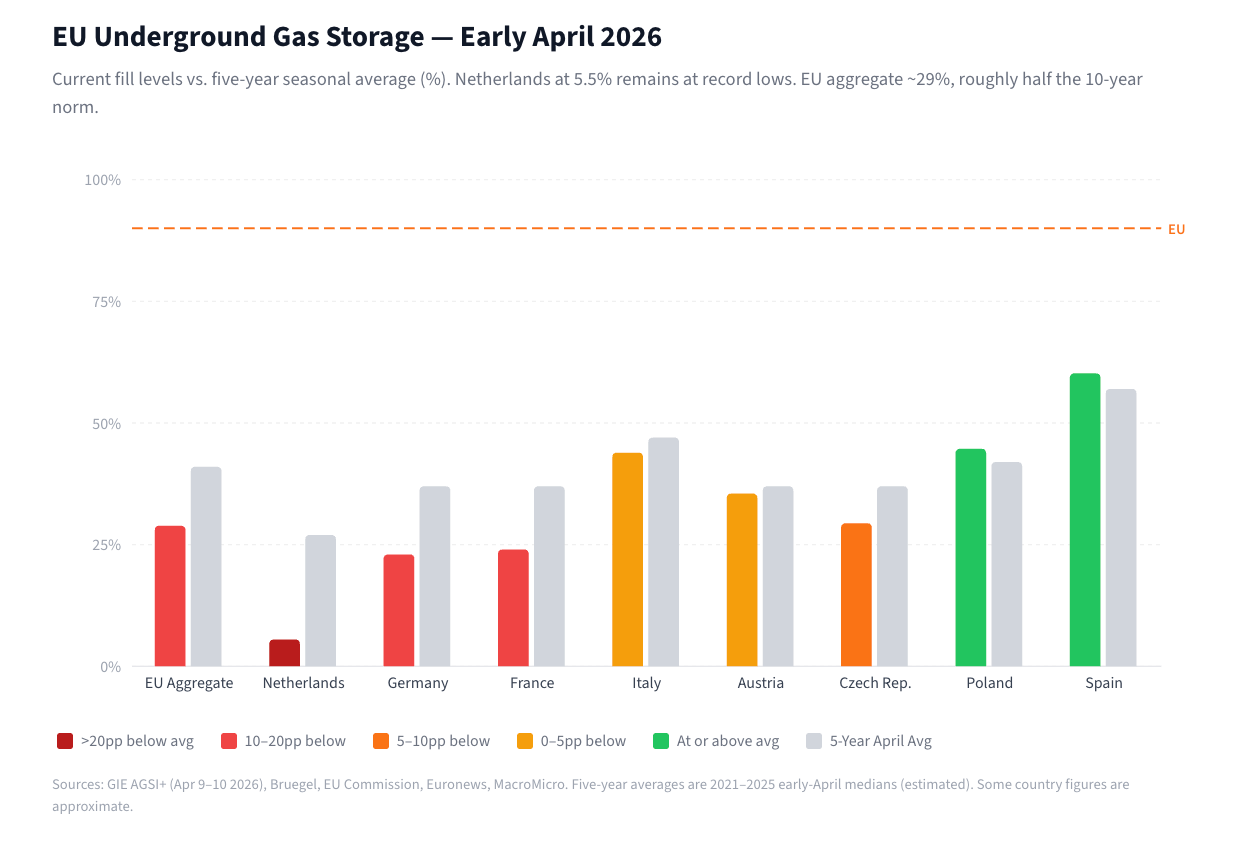
The Dutch find themselves in quite a pickle as per the above storage levels, and I would imagine a number of the wells they haven’t poured concrete down will be restarted in the coming months (Netherlands passes law to permanently shut Groningen gas field).
The Big Switch
At current JKM spot prices of ~$15.8/MMBtu, Asian LNG trades three to four times above the coal-to-gas switching threshold in virtually every market. The consensus switching range sits at $6–9/MMBtu for Northeast Asia (Japan, Korea, coastal China) and just $3–5/MMBtu for emerging South and Southeast Asia, where cheap domestic or Indonesian sub-bituminous coal dominates fuel supply.
China treats LNG as the marginal, swing molecule in its gas supply stack. Contracted volumes get absorbed, but spot purchases are ruthlessly price-sensitive. With 42–50% of gas demand in the industrial sector, where dual-fuel capability is widespread, and coal remains far cheaper. China has retrofitted for flexibility 360KW of its coal fleet (30%) and when you include new coal plants, half of China’s 1200KW of coal capacity is now flexible.
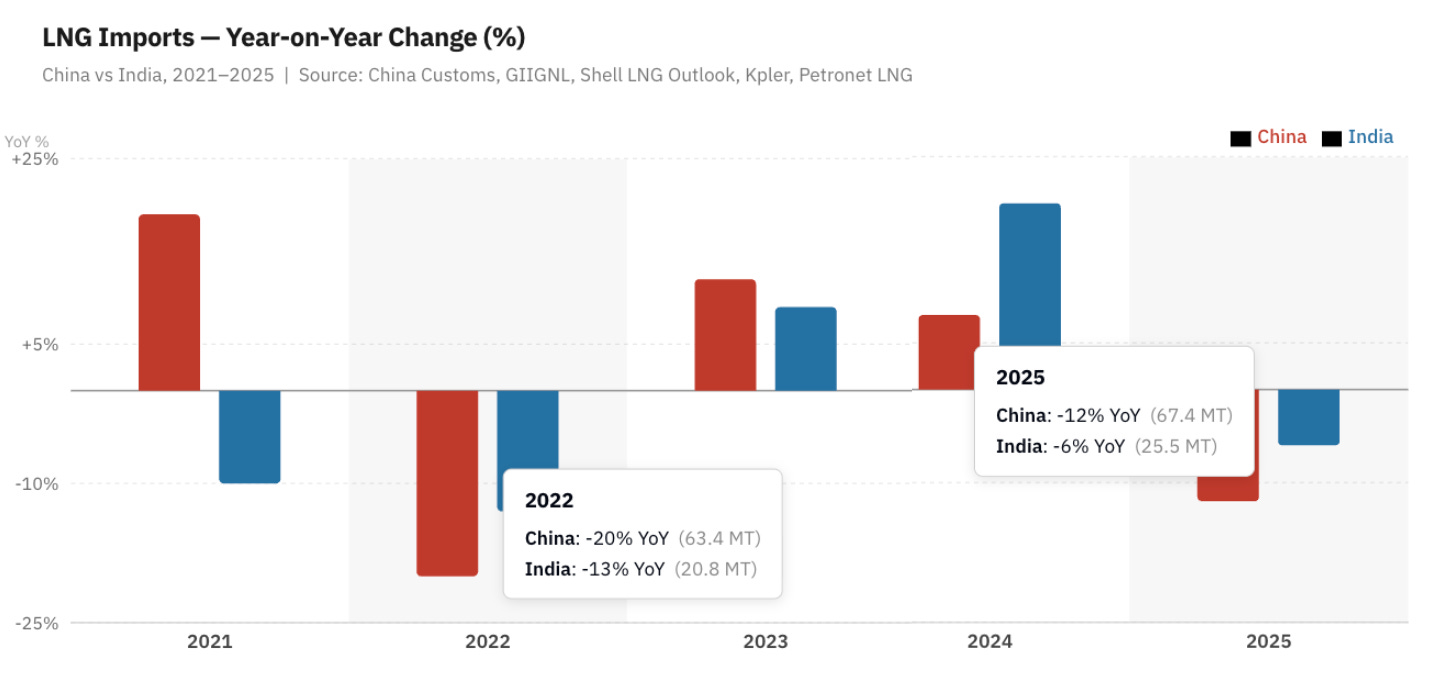
Chinese industry is highly price-sensitive and simply won’t show up if prices are too high, as the 2022 energy crisis illustrated, with Chinese LNG imports falling by 20%. Chinese buyers withdrew from spot markets entirely when prices exceeded $43/MMBtu in H2 2022.
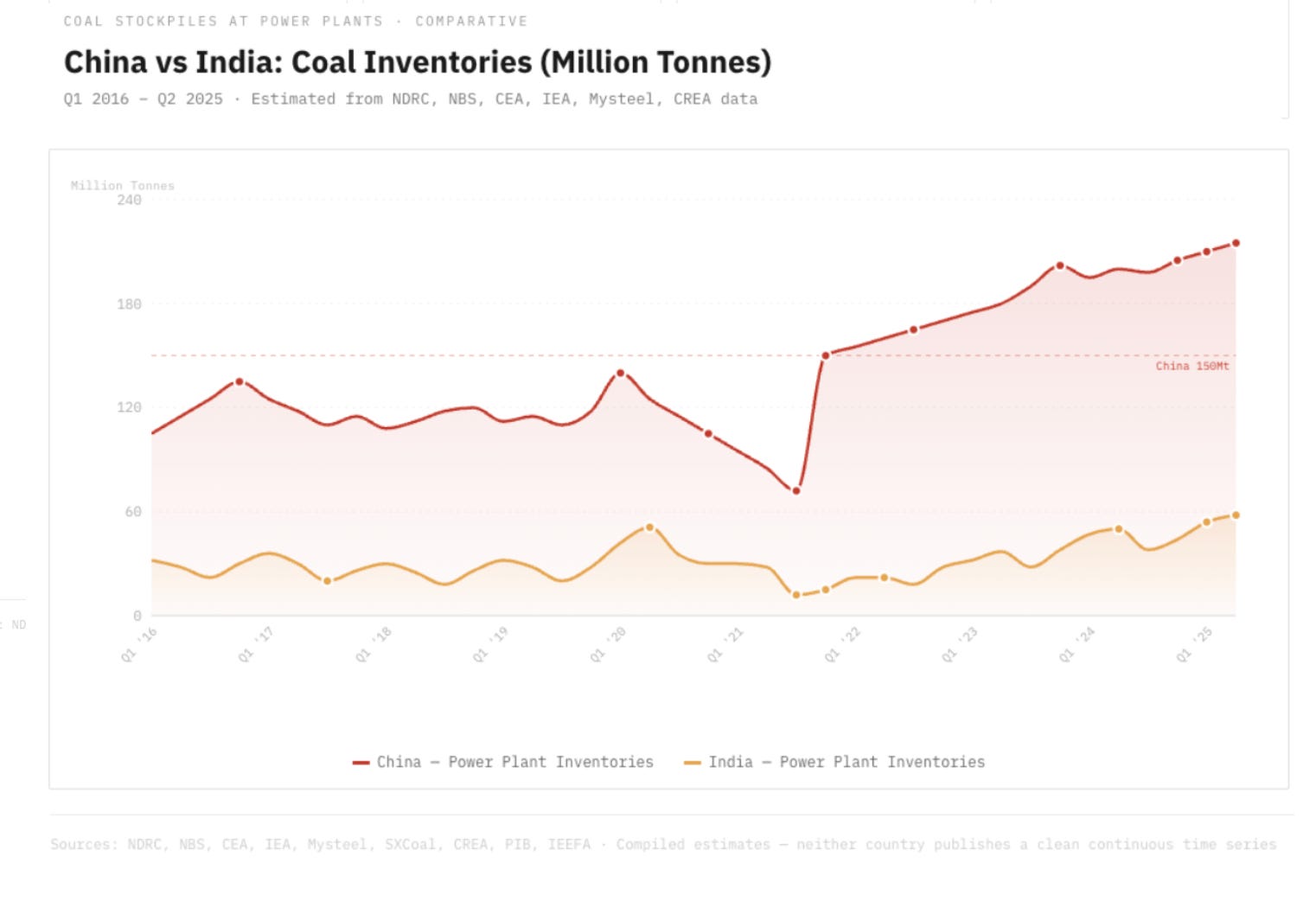
China aren’t short of coal inventories this time either.
This has been a blessing to Asian countries: China, well-positioned in a tight global market, sells record LNG volumes.
China, the world’s largest importer of LNG, reloaded between 8 and 10 cargoes during March, a record monthly total, according to analysts ICIS, Kpler, and Vortexa. Kpler data showed that China reloaded 1,31 million metric tonnes of LNG so far this year. Of these, 10 were delivered to South Korea and five to Thailand, while the rest went to Japan, India, and the Philippines.
Granted, these prices are really hurting poorer Asian countries, especially given the subsidies. Which brings me to my next point, that this is the second time they have been burned in 4 years.
Fool me once (in 2022), shame on you, fool me twice, shame on me….
The second-largest LNG demand driver in Asia Pacific, and in ASEAN, is power generation.
Vietnam, the Philippines, Indonesia and Thailand all have large proposed gas build-outs which will likely be shelved until Qatar expansions come online or get scrapped altogether in favour of coal and solar (which makes a heap of sense for Asia’s HVAC demand profile during the day).
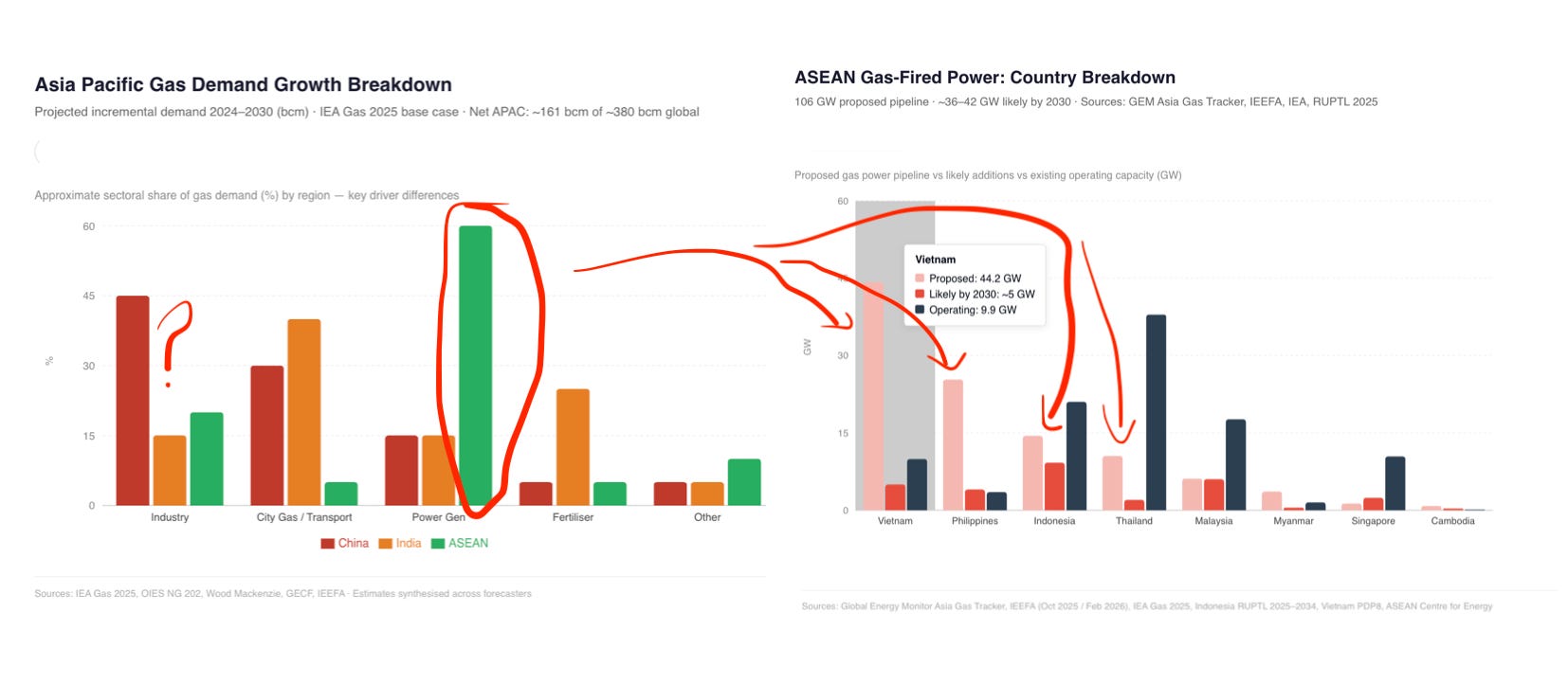
Each successive price crisis damages Asia’s gas demand growth trajectory, as countries revert to coal and accelerate renewables and rather than building new LNG infrastructure (which is rational when they know they will be outbid/unable to source LNG supply in a crisis).
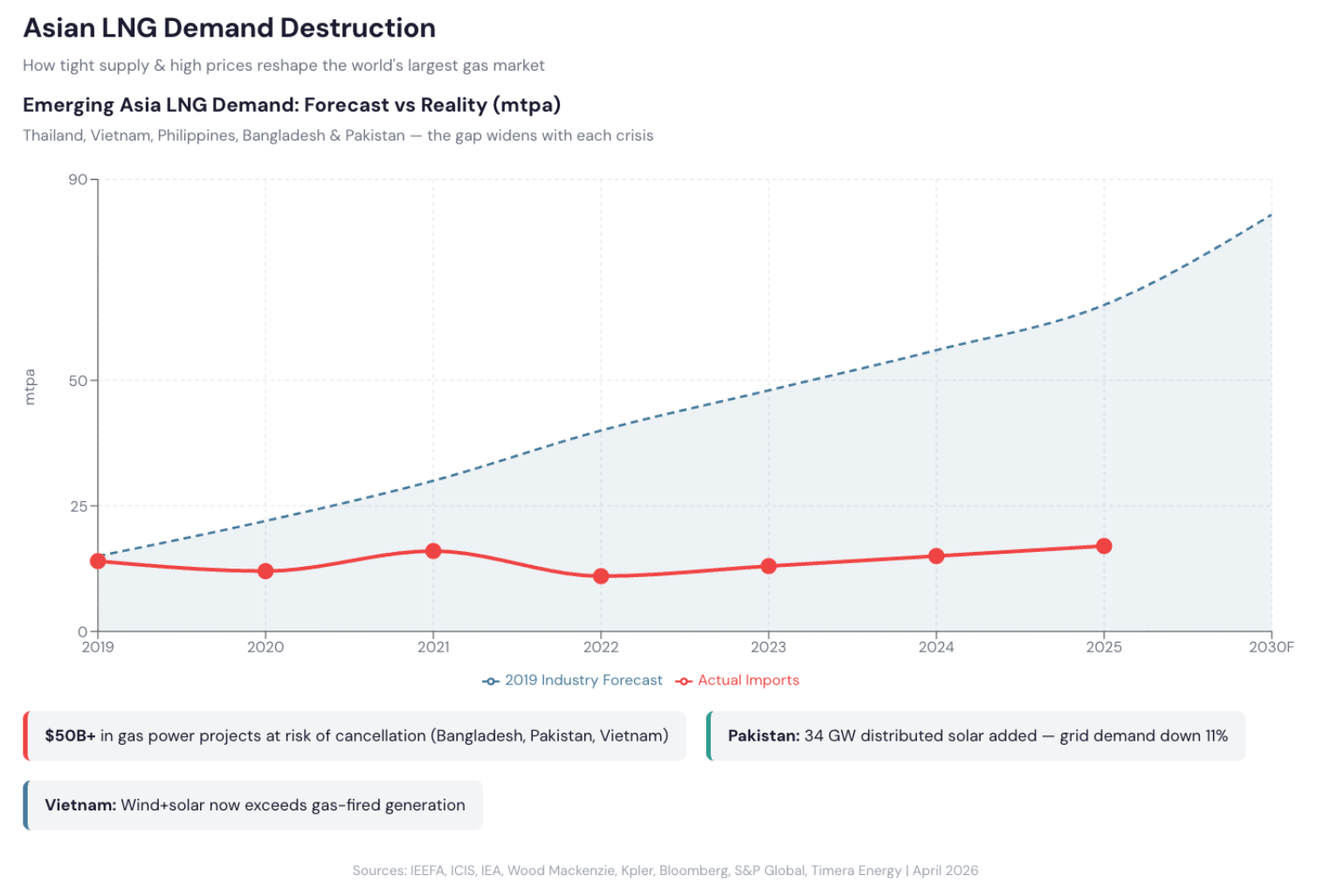
Pakistan is the case study, as in 2022, it went without a single spot cargo for over a year, completely outbid by European buyers.
Asia will max out their coal utilisation from here to help counter the LNG shortfall, granted the likes of Taiwan and India already run their plants at a high utilisation, so have less “headroom”
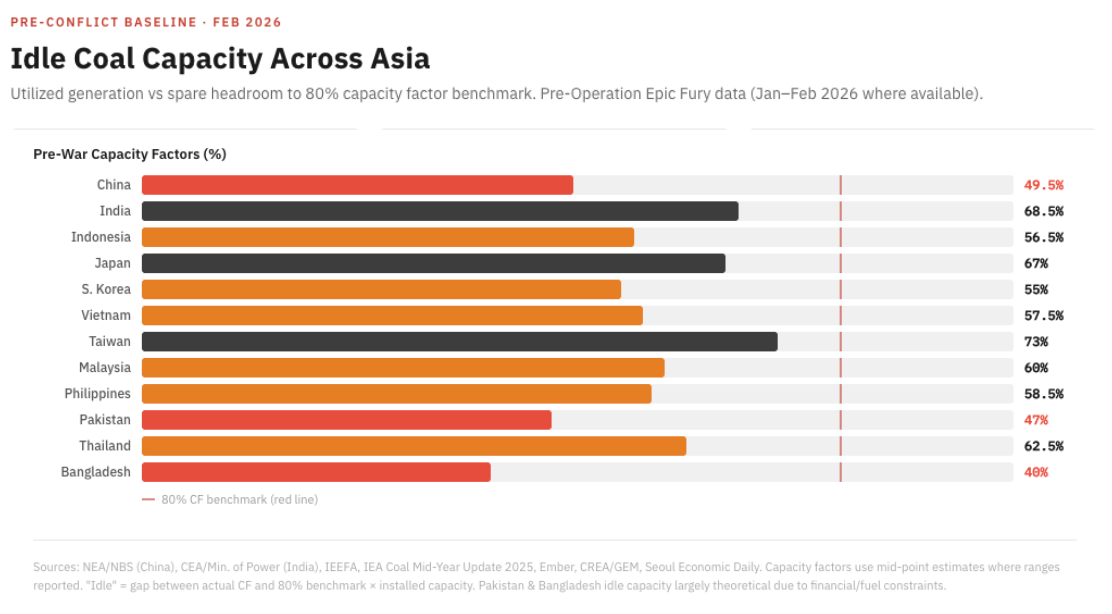
We are already seeing this show up in headlines;
Taiwan Pivots to Coal Power as War Disrupts Global LNG Market
Indian Power Ministry directs imported coal based plants to run at full capacity from April 1
South Korea to lift coal cap, boost nuclear output amid Iran crisis
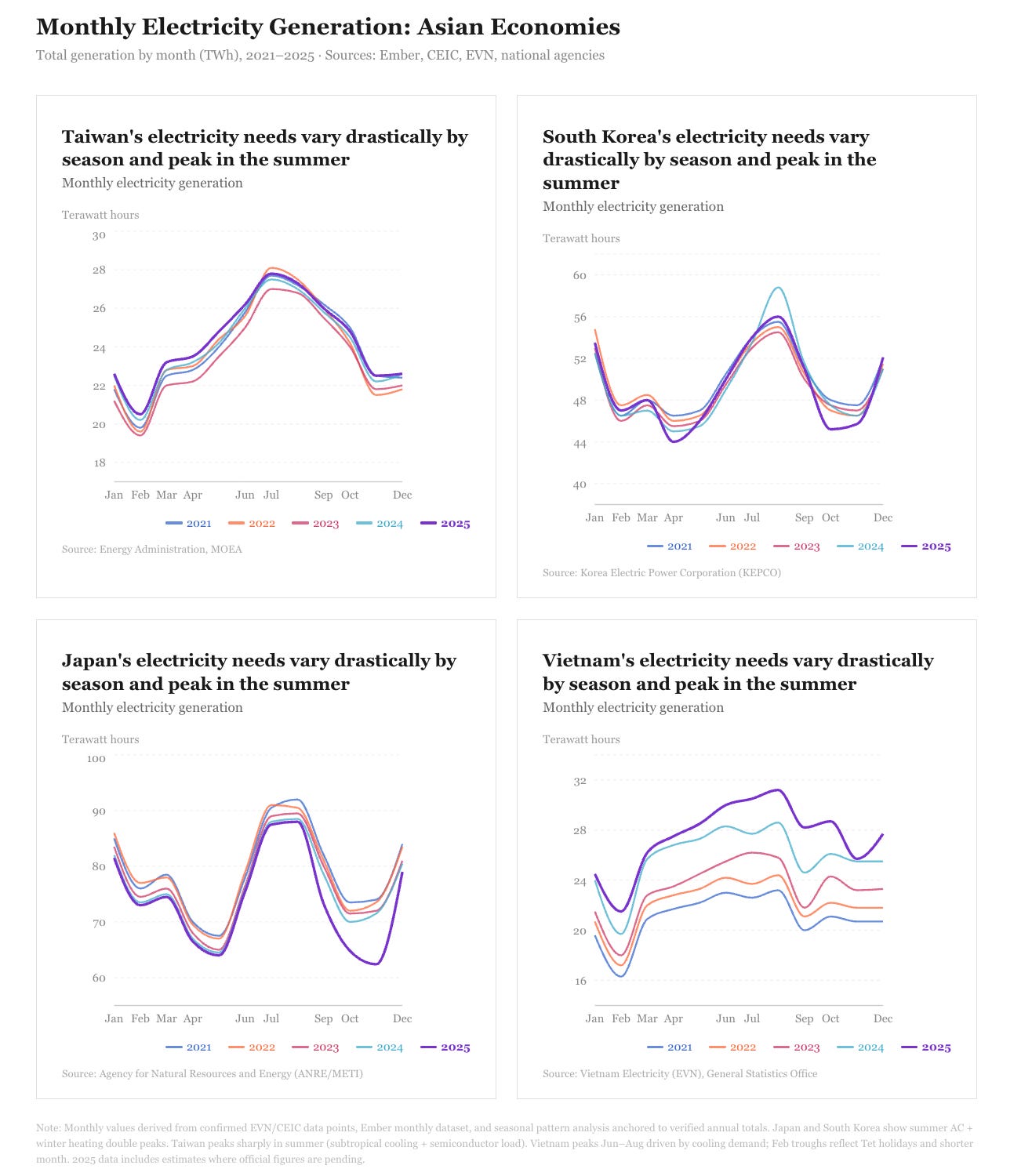
Asia will push its coal utilisation to the max over the coming months as we head into their peak cooling season, with electricity consumption going vertical from here, right when their LNG storage is running dry, and no Qatar LNG transiting Hormuz (90% of Qatar LNG heads to Asia).