

A lot of global macro is astrology for suits.
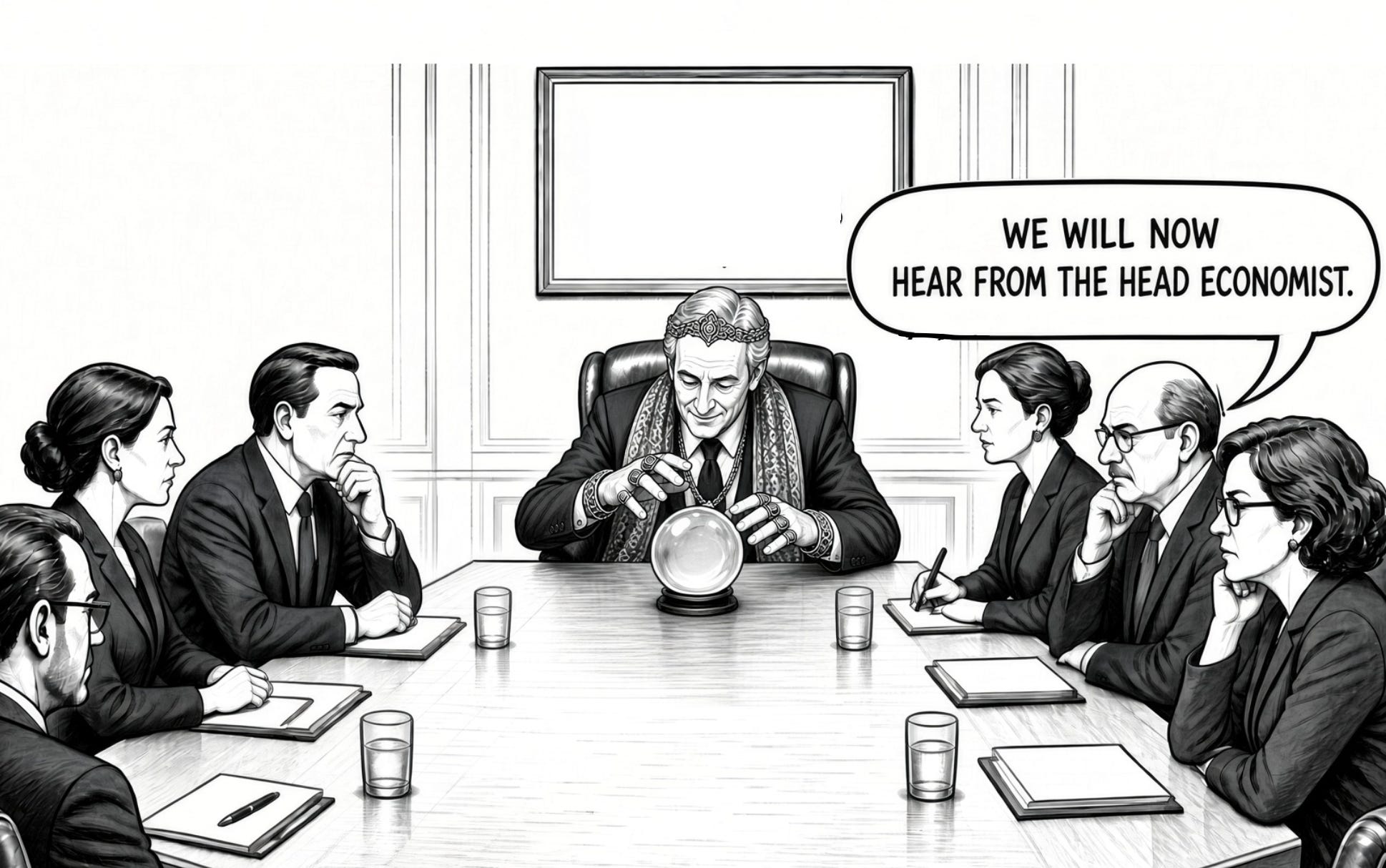
My mentor Brad’s always kept me grounded in this regard; as soon as I dabble in some astrology, he replies;
That’s interesting, Ferg, how do I make money off that?
The big macro question, and one I think you can make a lot of money on if you get it right, is: where is this Asian surplus going to be recycled?
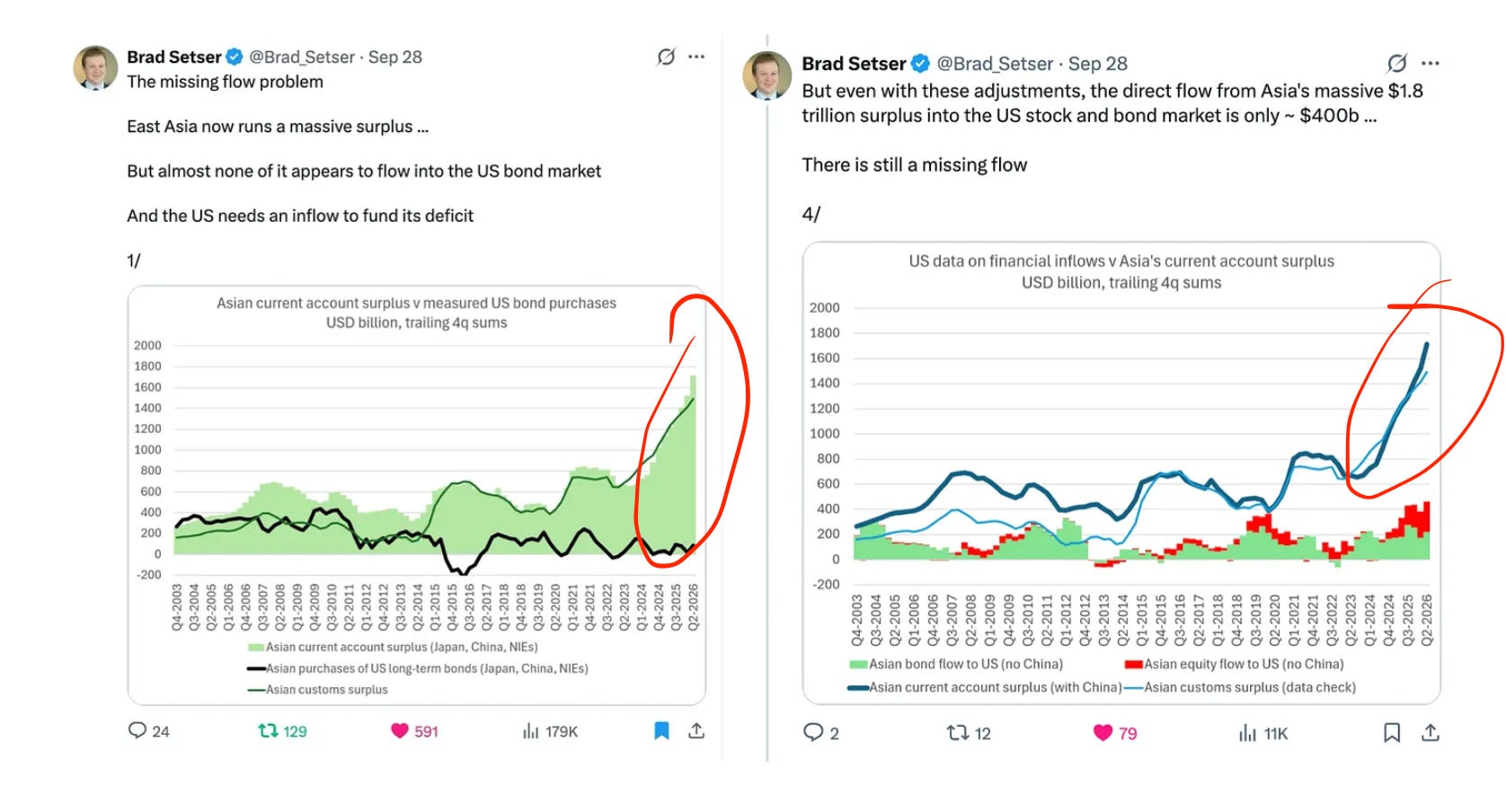
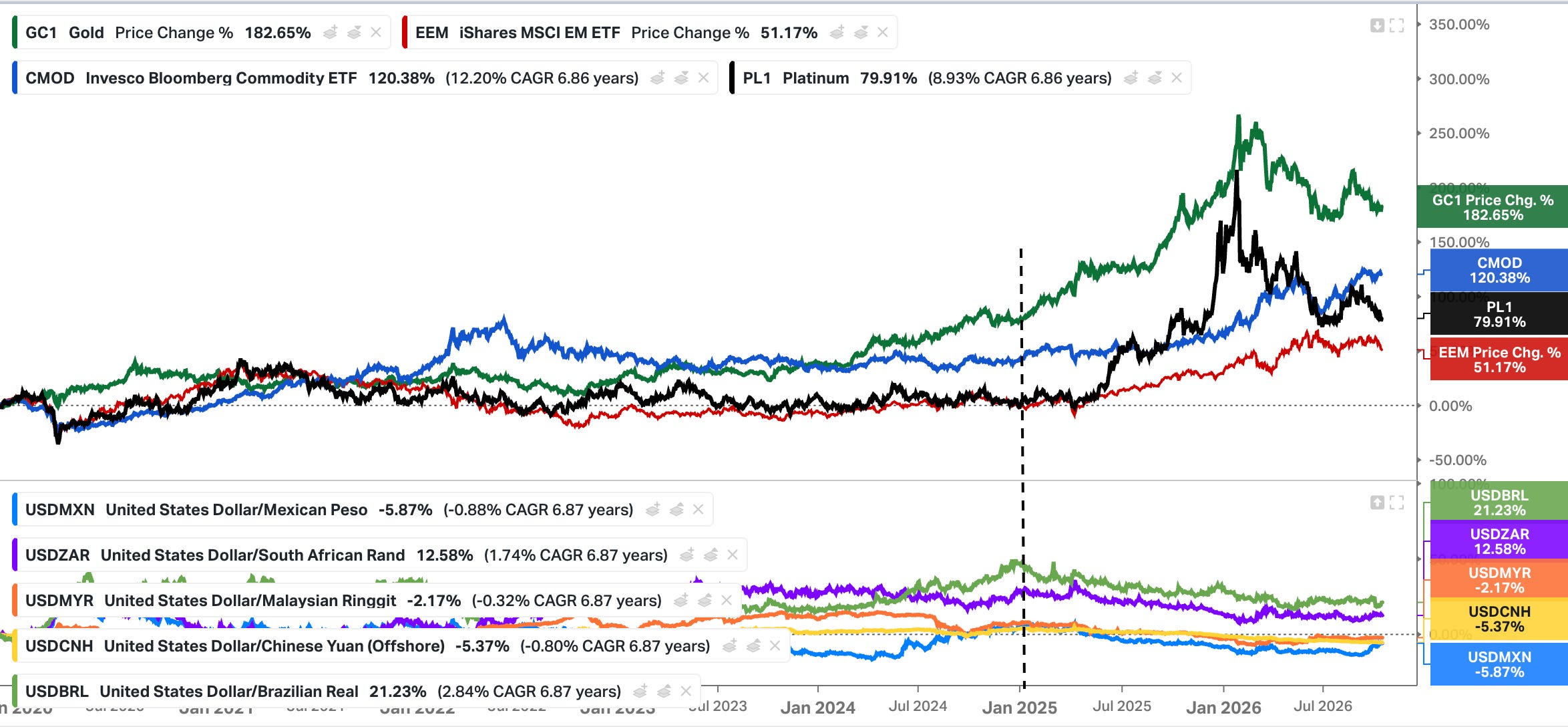
The Asian surplus (mostly China) really took off at the end of 2024, and I don’t think it’s a coincidence that gold, commodities, EM markets, and EM currencies all followed suit. Yes, $400 billion is still finding its way into US assets (mainly equities/US Tech).
I’m a terrible technical analyst, but I do respect the “big finger” technical formation the QQQ/EEM ratio just made.
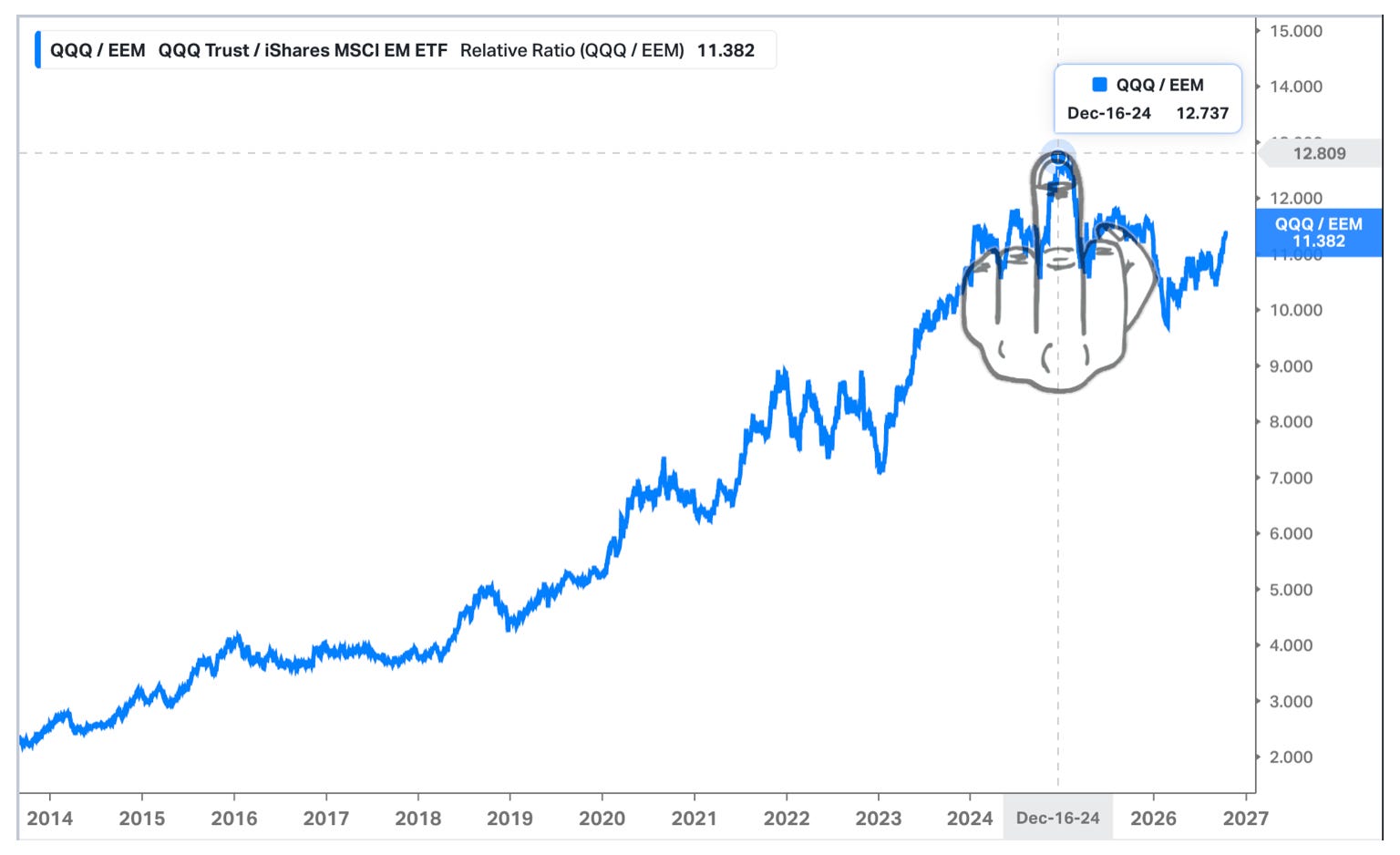
Or, zooming out to understand the significance of the bottom we saw in EM and EM currencies at the end of 2024.
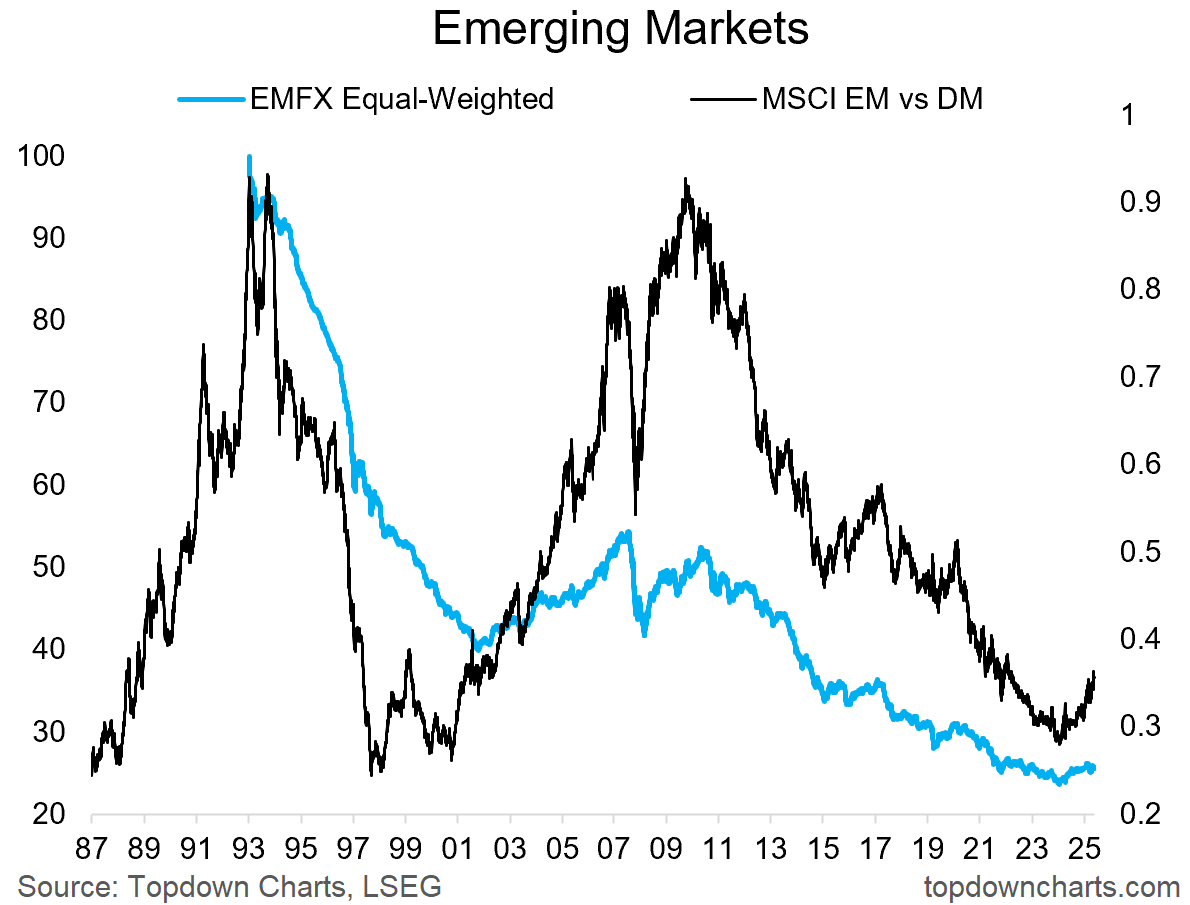
That’s interesting Ferg, how do I make money off that?
If I’m to break it into three sections
Commodities China/Asia wants
Emerging & Frontier countries which stand to benefit
The Resiliency theme.
Commodities China/Asia wants
Gold is the obvious beneficiary of Asian surplus no longer being recycled into Treasuries, along with commodities across the board (a simple rule of thumb is to buy what China is a net importer of and has export restrictions on or makes difficult to export (bar value-added goods). I’ve referred to this as the one-way valve with likes of gold, PGMs, and uranium (opportunistic exporter of enriched).
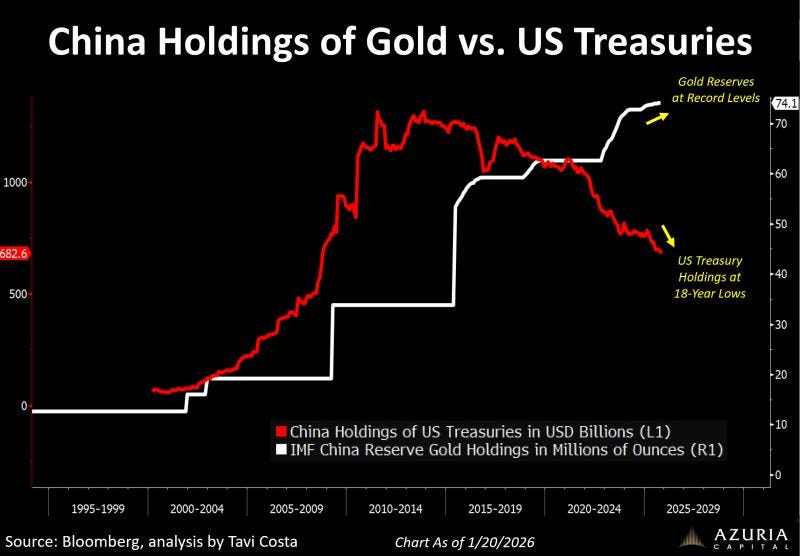
The US’s largest export over the last decade has been its debt, with its equities taking the baton since 2024. Private foreign net purchases of US equities grew from $282B (2024) to $686B (2025) and $521B YTD (August 2026), while Treasuries dropped from $517B (2024) to $457B (2025) to $154B YTD (July 2026). With this context, I’ll point you to this headline that reads like positive news, until you read what the main driver was…

Exports jumped 5.5% to an all-time high of $302.1 billion in January. The increase was the largest since October 2021. Goods exports soared 8.1% to $195.5 billion. They were boosted by a $9.4 billion increase in exports of industrial supplies and materials, mostly nonmonetary gold and other precious metals.
Gold Beat Aircraft and Oil to Top America’s Export List. Nobody Agrees Why.
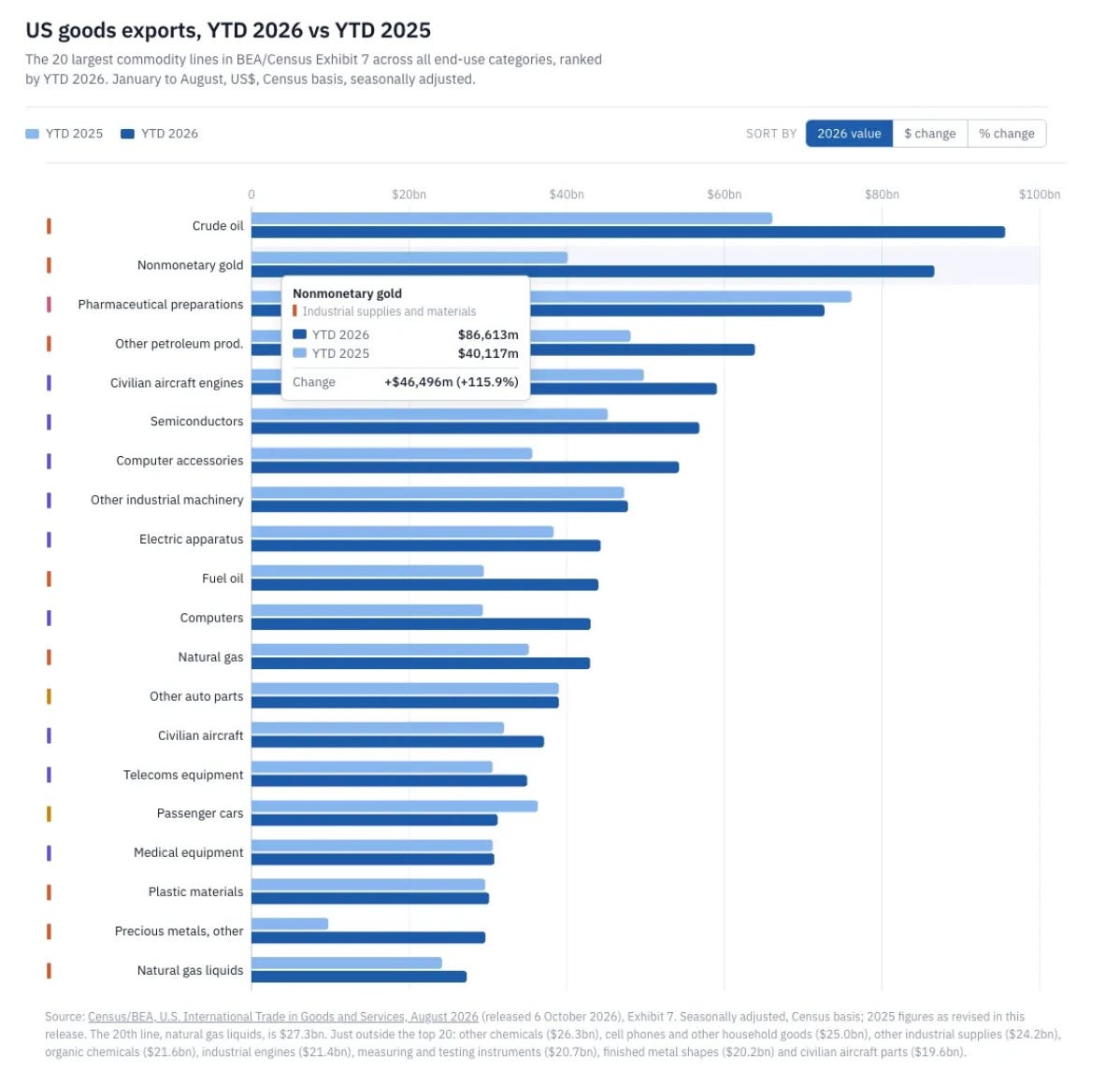
Or via meme.
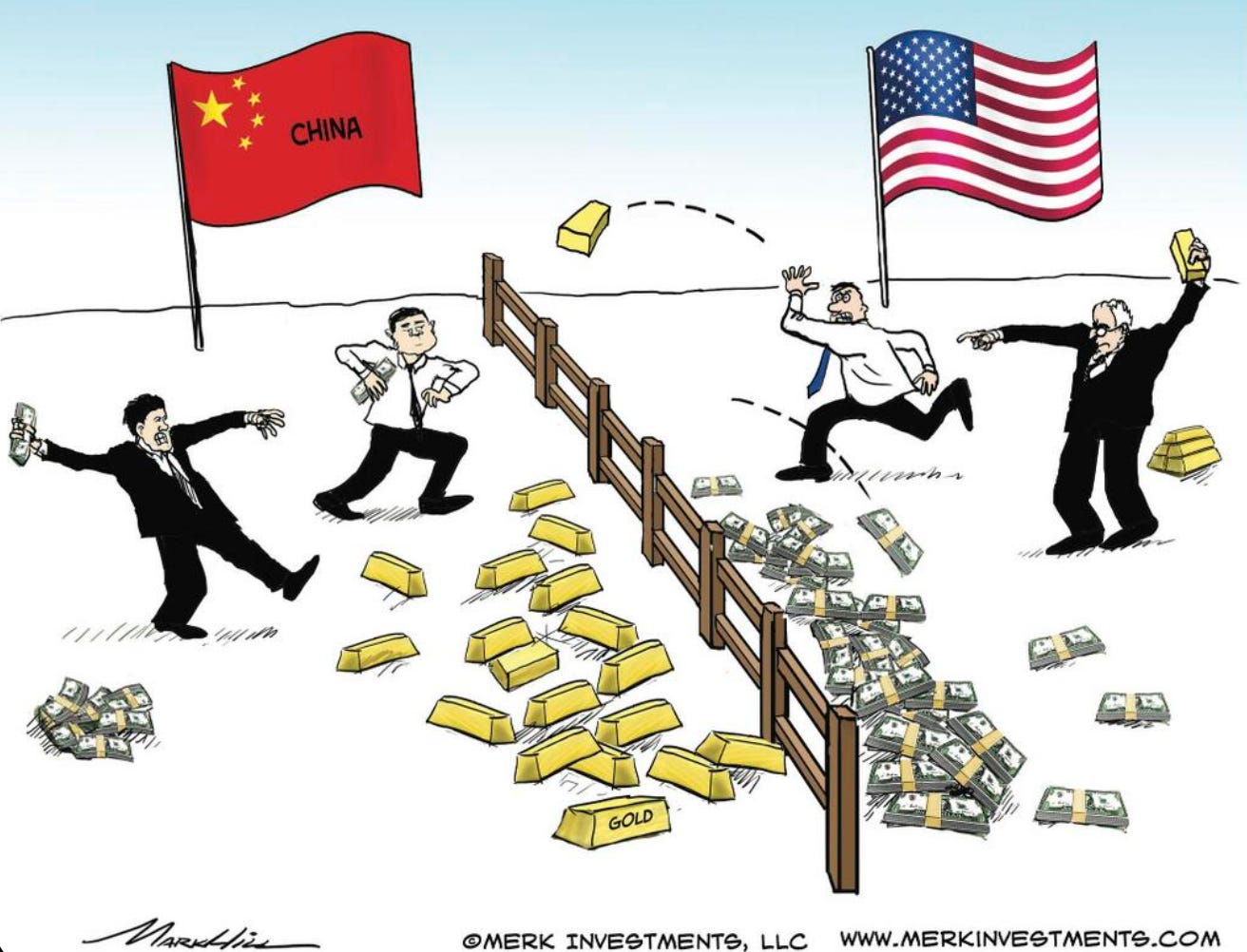
Takeaway: You’d be crazy not to have a sizeable allocation to precious metals here if you have a long-term investment horizon. You can debate the optimal way to approach it (I’m selling my GDXJ for a “better basket”, which I’ll cover in my next piece).
Emerging & Frontier countries that stand to benefit
As I went over in Frontiering I believe the a bull market in emerging and frontier markets is just getting warmed up.
With all the focus on AI and US tech, you’ve actually been better off recently in emerging markets or frontier (if they hadn’t scrapped the ETF). In EEM you’re sitting on a forward PE of 9.7x compared to 22x QQQ and 20x SPY (yes, I’m not a fan of EEM’s 25% in TSMC, SK Hynix, and Samsung Electronics, but if you replace it with EYLD you’ve actually done even better while sitting on a 9x forward PE and all positions ~1%).
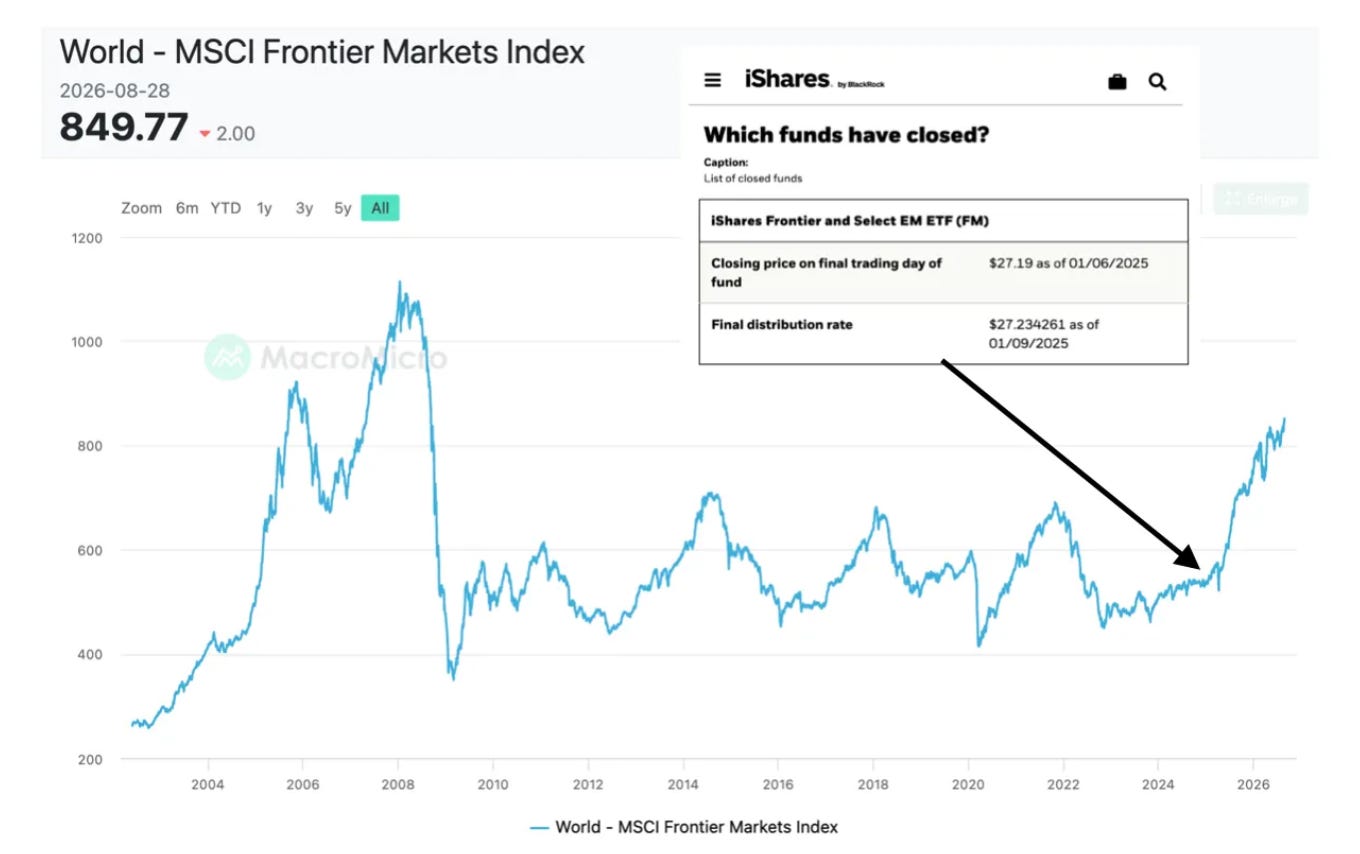

Emerging and frontier markets have been hollowed out by a decade of underinvestment, so it doesn’t take much of an increase in investment flows to move the needle (my rule of thumb: the last market or sector ETF being dropped/delisted often marks the bottom).
Growth in direct foreign investment is one such flow.
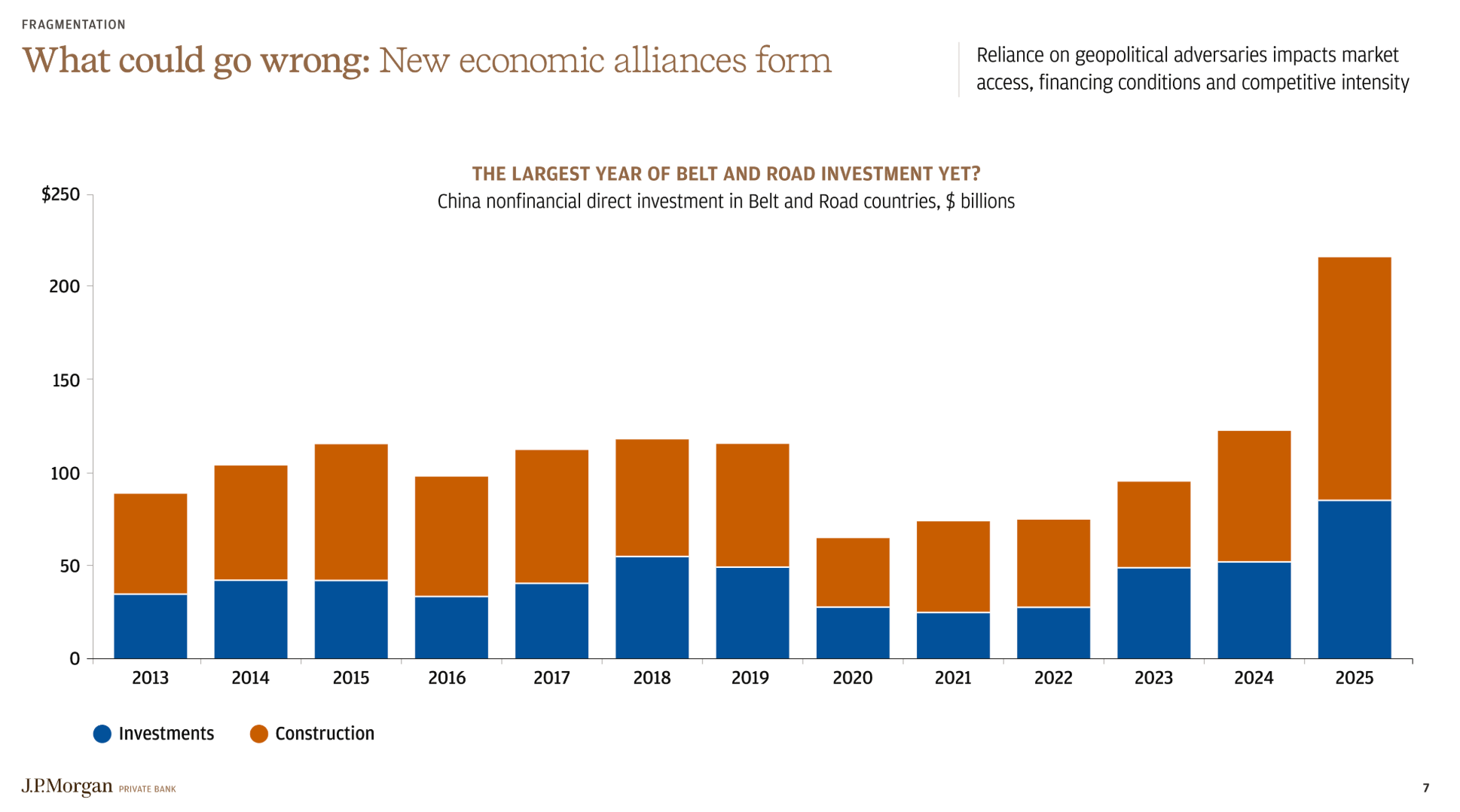
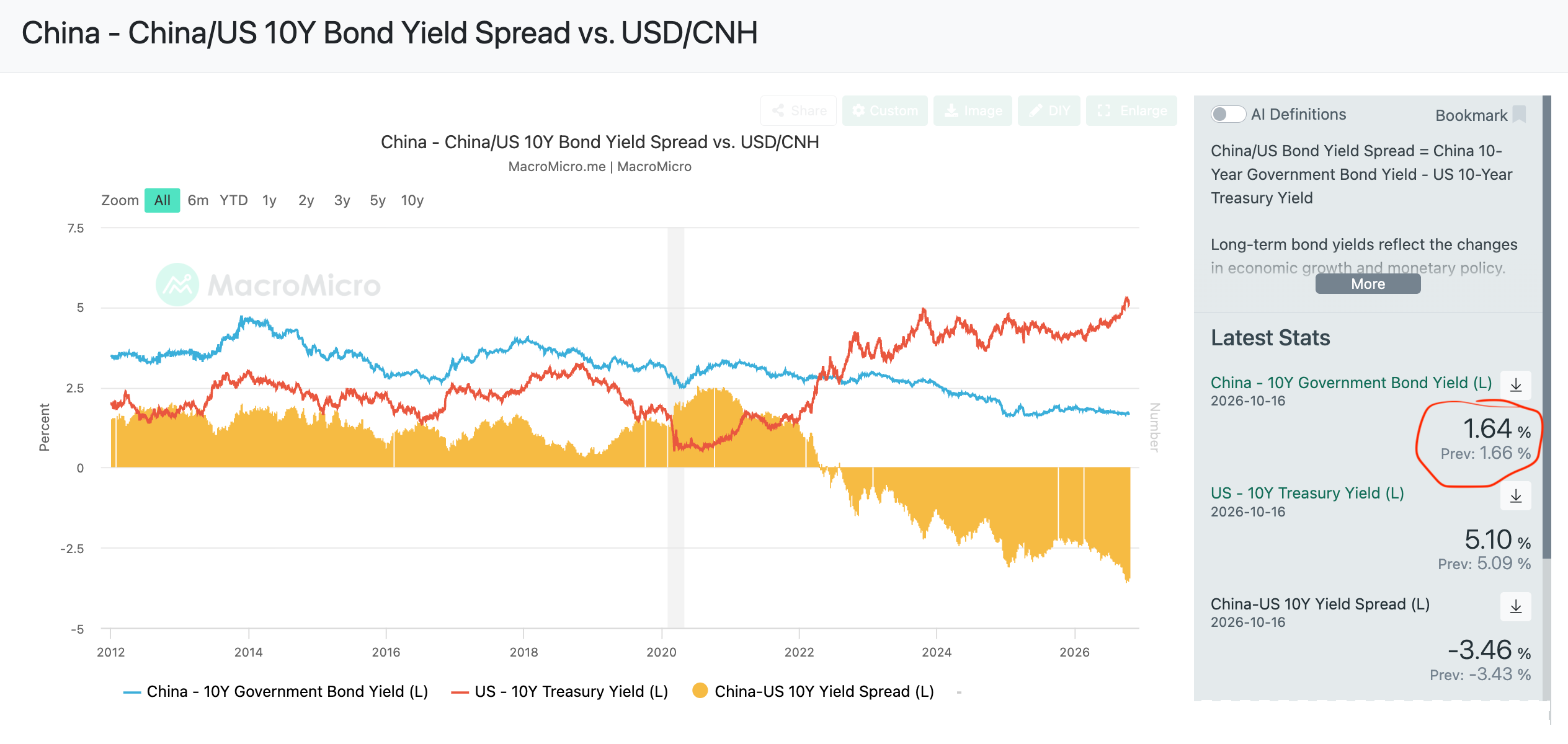
While China’s growth competitiveness has hurt many Western companies (think Automakers), most EMs and FM’s are massive net beneficiaries of Chinese competitiveness. Think cheap vehicles, machinery, 5G, and nuclear reactors on attractive financing (see how wide the spread has got!)
Here are a few examples:
Chinese companies to invest up to $7 billion in Congo mining infrastructure
Iraq secures oil-backed loan for Power Stations Reconstruction Project
Chinese government pledges sellers credit for Chashma Nuclear Power Project Unit 5 in Pakistan
Huawei, ZTE seal 5G deals in Vietnam after US tariffs, as ties with China warm
Countries already blessed with commodities stand to benefit most, which is why I believe the likes of Brazil are going to have a fantastic decade of outperformance.
ASEAN is a likely beneficiary, as you can already see in trade, though they’re currently having a rough time with energy costs.
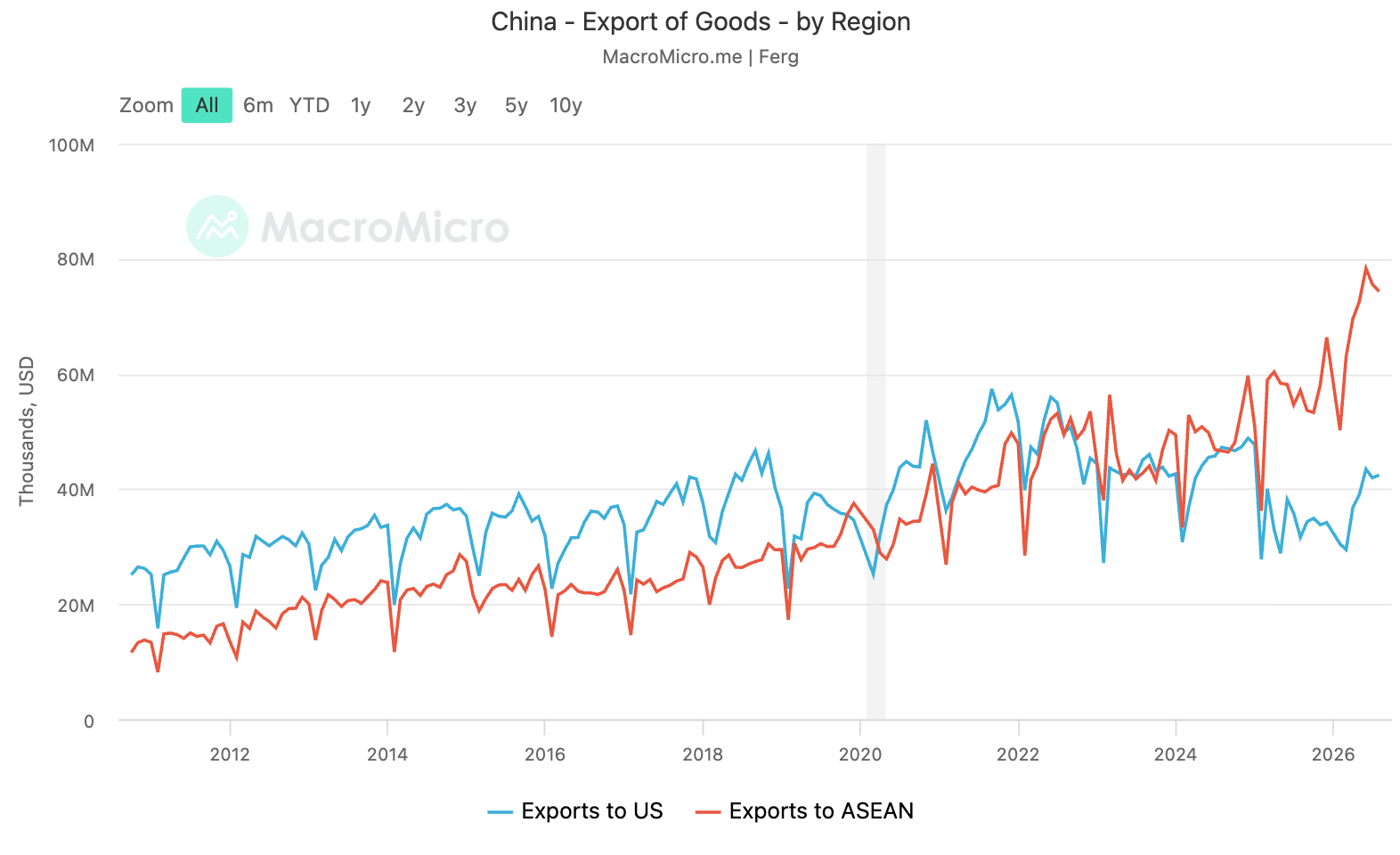
Takeaway: This is a big trend I plan to ride over the next decade through a mix of exchange operators, EM banks, and high-shareholder-yield hard-asset companies (as I covered in Hugo’s Portfolio).
Another key tailwind with emerging and frontier markets is that multiple compression is largely behind us.
I’ve always thought of multiples as enthusiasm for a business/industry/sector; if it’s against you, it’s brutal regardless of growing earnings and improving fundamentals. If it stays stable, it’s what you counted on; steadily growing multiples are a massive tailwind for performance. Take the three EM exchange operators below, where investors were willing to pay 25x PEs back in 2013 vs 10-13x today.

The Resiliency theme
The globalisation trend involved not only “just in time goods” but also just-in-time energy/fert/chemicals, as Western countries outsourced not only manufacturing but everything dirty in processing, refining, drilling, and mining. Net Zero was predicated on the assumption that when the wind didn’t blow, or the sun didn’t shine, you’d have “just-in-time LNG”, while shuttering “just in case” nuclear and coal in Germany and Taiwan. The consequences of this short-sightedness are playing out right now.
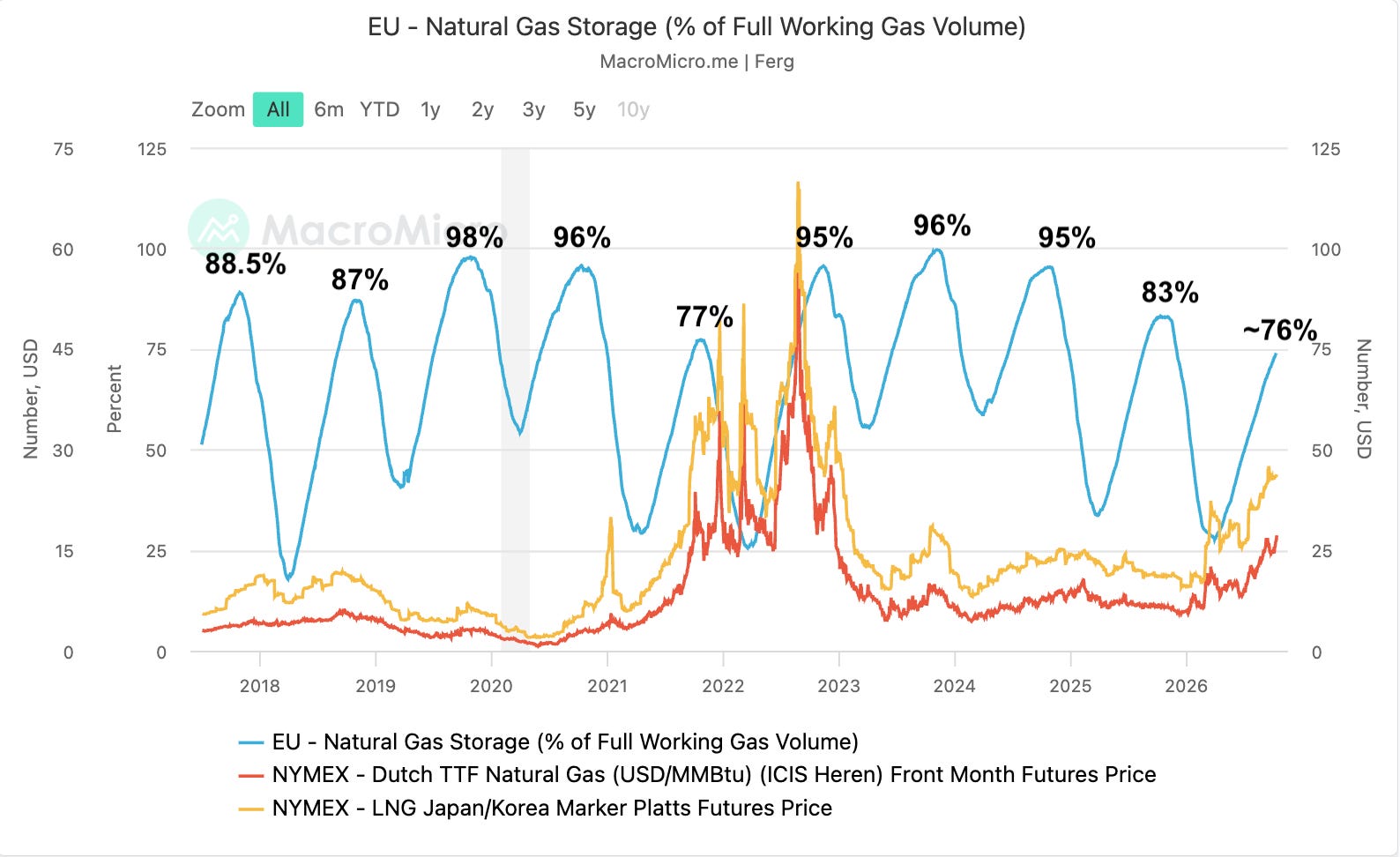
It’s a coin flip whether Europe gets through this winter without a severe energy crisis and is forced to price out all competitors for the LNG it needs. Even if the EU gets lucky with a record-warm winter, we will still face the “Big Refill” as everyone tries to refill their SPRs and expand emergency reserves at the same time, aka hoarding…
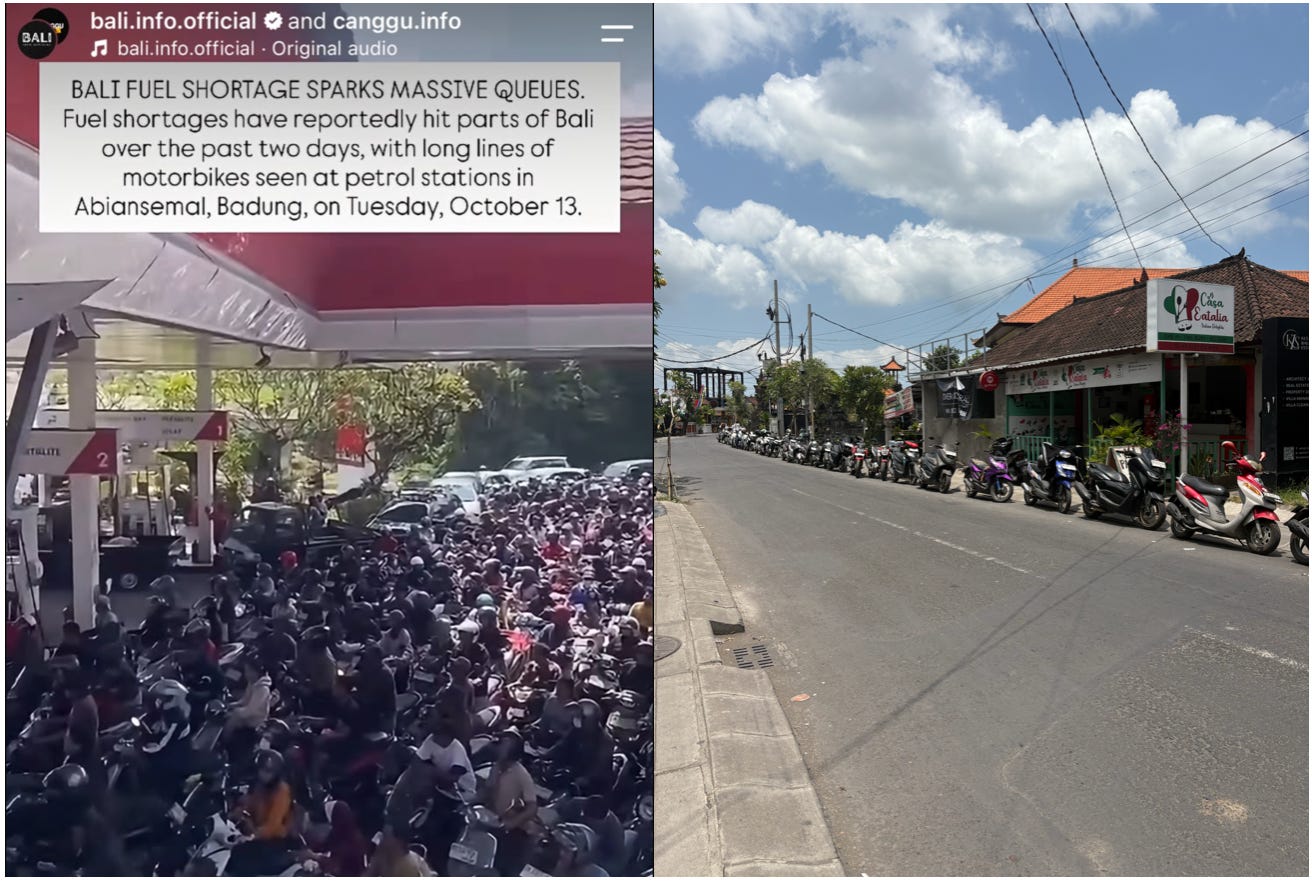
Take Bali, where we’re experiencing a fuel shortage currently, with lines hundreds of metres long and bikes being left on the street to hold their spot in the queue until the next fuel truck arrives (today they started a rationing system: number plates ending with certain numbers can fill up on certain days and are limited to 20L for a car and 3L for a bike/scooter).
Thermal Coal
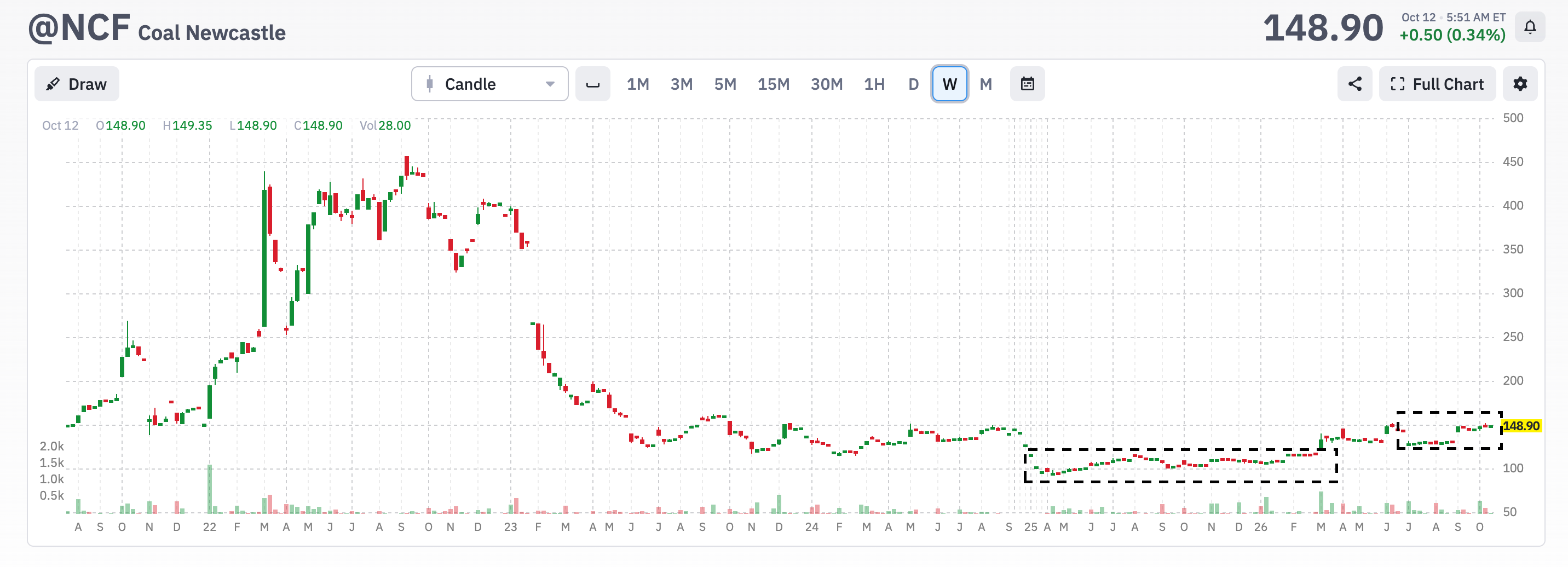
As LNG prices continue climbing, it’s Asia that gets priced out. Asia’s response is predictable: max out coal utilisation and even start building new coal plants. I maintain this is one of the best setups in this market right now, as the equities aren’t reflecting where thermal prices are yet, let alone where I think they are heading.
While this chart is a bit old, it’s a great visual for the fact that coal is Asia’s growth engine, and the only way to displace coal is with a cheaper alternative (which was the promise of LNG until Hormuz/Qatar got choked off). Asia Pacific has abundant coal and accounts for 80% of global coal production and 43% of reserves (compared with 17% of production and 9% of reserves for natural gas).
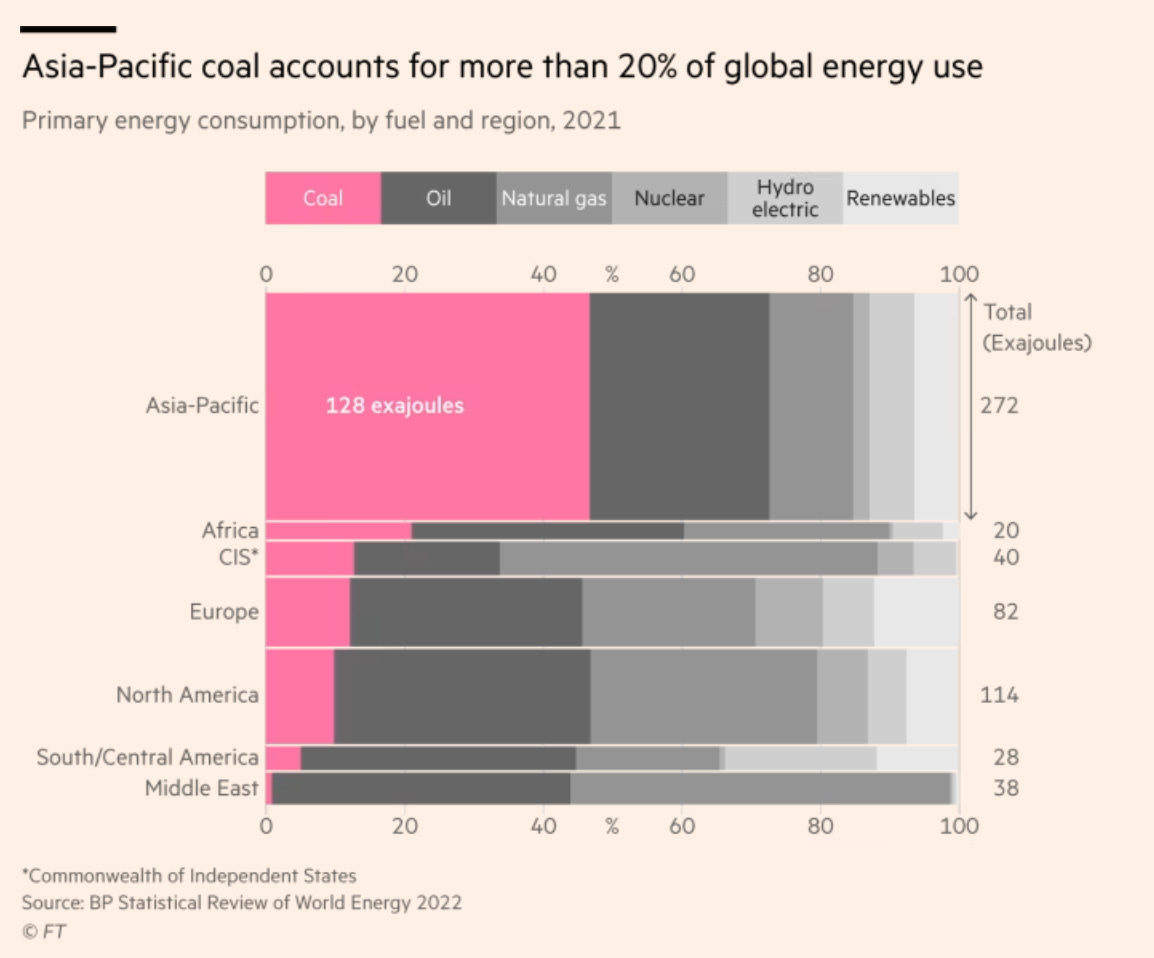
Yes, solar and nuclear make a lot of sense, but they will take time. If there is an order of operations, it would be: Big Refill (hoard all you can), diversify energy sources, boost coal generation, renewables and lastly nuclear.
“Just in time, to just in case”
With LNG through the Hormuz Strait choked off, poorer Asian countries are reconsidering their increasing dependence on LNG.
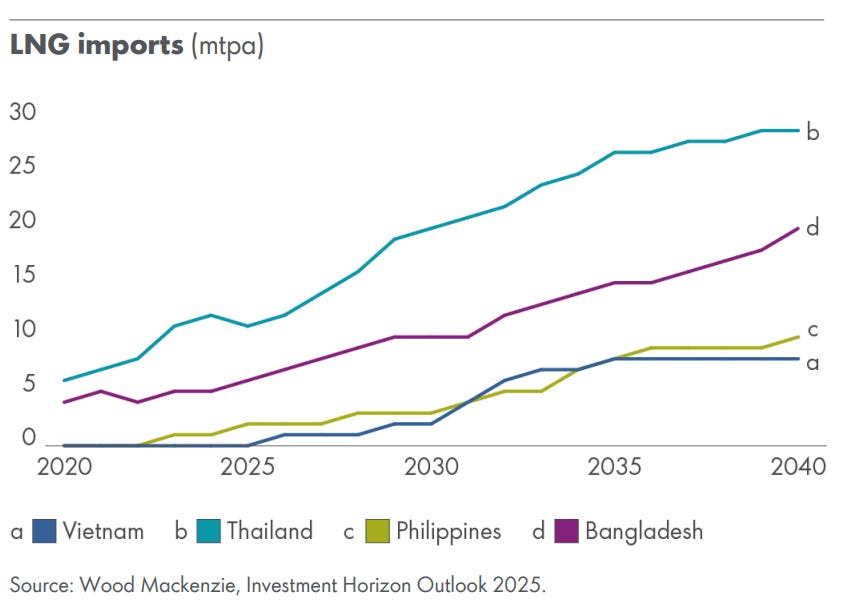
Vietnam looks at more coal power plants as Iran war complicates LNG plans
HANOI, July 8 (Reuters) - Vietnam’s government is considering building more coal-fired power plants to ensure it can meet its energy needs, the government said on Wednesday, as the Iran war further complicates its slow development of LNG facilities.
The Southeast Asian manufacturing hub is seeking to ramp up its power generation capacity to support its fast-growing economy, with a focus on renewables and LNG.
DOE plans to restart coal capacity buildup
MANILA, Philippines — The Department of Energy (DOE) is seeking to fast-track up to 5,000 megawatts of new coal-fired capacity to avert blackouts as the country ramps up its rollout of renewable power.
Bangladesh: Govt plan to open mine, expand coal-fired power plants stirs controversy
But on August 16, 2026, Finance Minister Amir Khosru Mahmud Chowdhury told a media conference that the government was considering extraction of coal from Phulbari using the open-pit method that sparked widespread outrage.Prime Minister Tarique Rahman also announced recently that a 10-year energy master plan incorporating local coal extraction policy will soon be presented to parliament.
Following the announcement, Bangladesh has also given an in-principle go-ahead to expand coal-fired power generation by a further 2,640 megawatts (MW), with two mega projects expected to cost more than $3 billion.
Oil Services
Asia has learned a tough lesson about the need to diversify its energy sources, similar to Europe with Russian gas in 2022 (granted, the EU learned absolutely nothing, given where it finds itself today).
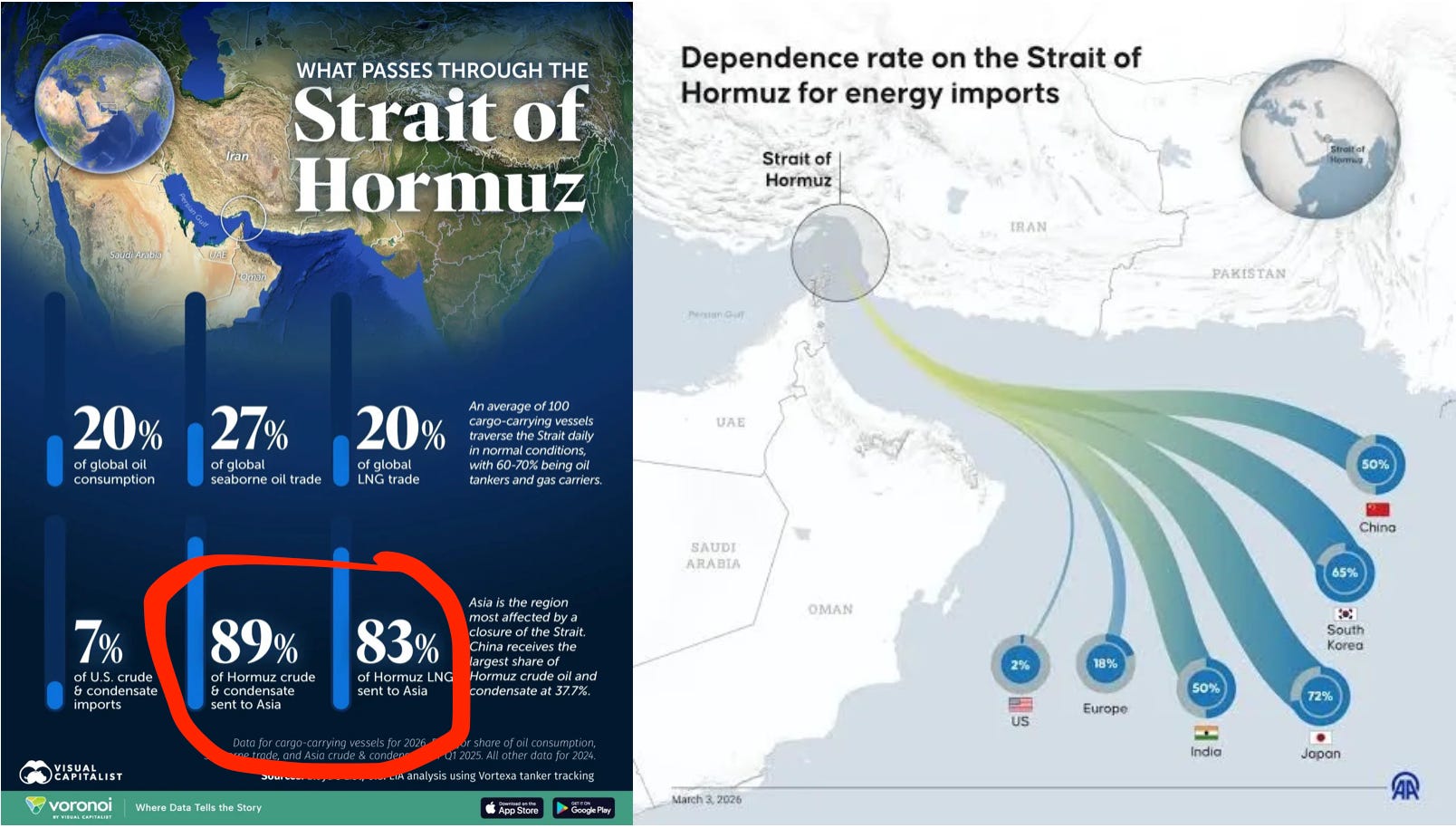
Asia isn’t going back to relying on 89% of its crude and 83% of its LNG flowing through Hormuz. Yes, it’s going to be more expensive and require new infrastructure to diversify to Brazil, Argentina, Venezuela, Canada, and Africa. This rearchitecting of Asia energy flows will be a windfall for oil services which have been hollowed out and consolidated after an extremely tough decade.
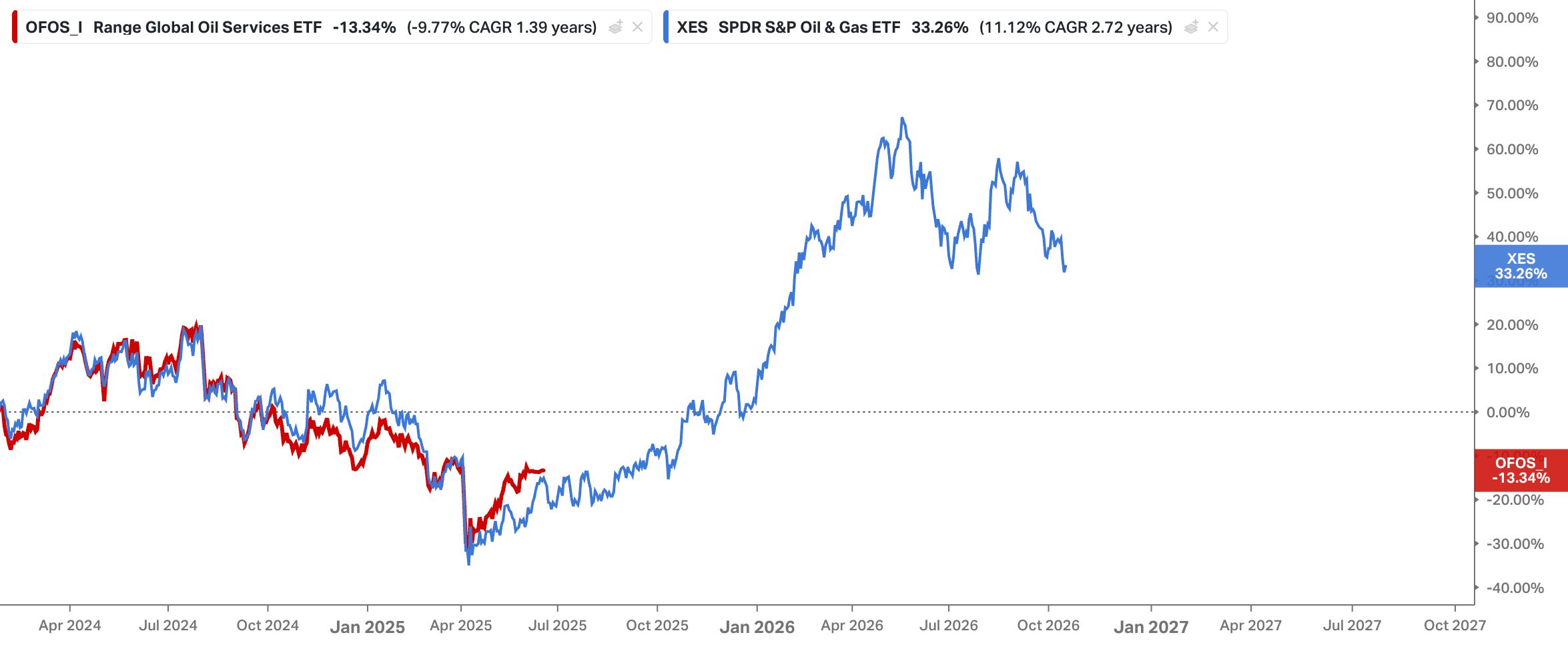
Takeaway: I’m already seeing utilisation tighten across many oil services sub-sectors that have been capital-starved and hollowed out for a decade. When investment flows try to squeeze in, this bull market will really get underway.
While XES has a broader mix of oil services, the Range Global Offshore Oil Services Index ETF being closed post Liberation Day marked the bottom in oil services for me.
Portfolio Review
I’ve let Claude loose on my Substack history and IBKR accounts to analyse my performance in an 80/20 review, i.e., what I should be doing more of and what I should cut out.
One big takeaway for me has been to double down on finding a superior angle to play a theme long term, in a way where I can be incrementally right (dividends, buybacks, debt paydown).
For example, I’m selecting a “champion” for each oil service subsector I’m bullish on (I’ll go over one I’m building a new position in).
I’m also changing how I’m approaching gold and selling all my GDXJ to fund it.
Cheers,
Ferg
TF - 500 Yr East/West cycle is unfolding and its investable (and inevitable).
Thank you for looking out the windshield and not fatally stuck in the rear view mirror. To the useless/lying msm we (avg investors) are bagholders: target date funds, private credit, private equity, A.I., treasuries etc. etc. etc.
Your work is vital and could only come from an independent source. Thank you.
The Iran War is a massive inflection point for all the world to see. "We are not in Kansas anymore."
There are always opportunities. This post was 10/10.
Thank you